|
November 2025 Legislative Newsletter
|
Dear Friends,
During this season of gratitude and celebration, I want to express my appreciation to you for the positive impact you are having in our community and state, and for the opportunity you’ve given me to represent you on Capitol Hill. I hope you had a wonderful Thanksgiving celebration last week.
|
It has been 404 years since the Pilgrims and Wampanoag Indians gathered at Plymouth for an autumn harvest celebration. Many years later, on October 3, 1863, four months after the Battle of Gettysburg (which resulted in more than 50,000 American casualties), President Abraham Lincoln issued a proclamation that resulted in Thanksgiving Day becoming a national holiday. The words in his proclamation are still pertinent and ring true today. I am grateful for our nation, state, local communities, and each of you. I hope that you and your families and friends may have a “full enjoyment of peace, harmony, tranquility and union.”
President Abraham Lincoln’s Proclamation:
“I do therefore invite my fellow citizens in every part of the United States, …to set apart and observe the last Thursday of November next, as a day of Thanksgiving… And I recommend to them that while offering up the ascriptions justly due to Him…, they do also, with humble penitence for our national perverseness and disobedience, commend to his tender care all those who have become widows, orphans, mourners or sufferers in the lamentable civil strife in which we are unavoidably engaged, and fervently implore the interposition of the Almighty Hand to heal the wounds of the nation and to restore it as soon as may be consistent with Divine purposes to the full enjoyment of peace, harmony, tranquility and Union.”
|
|
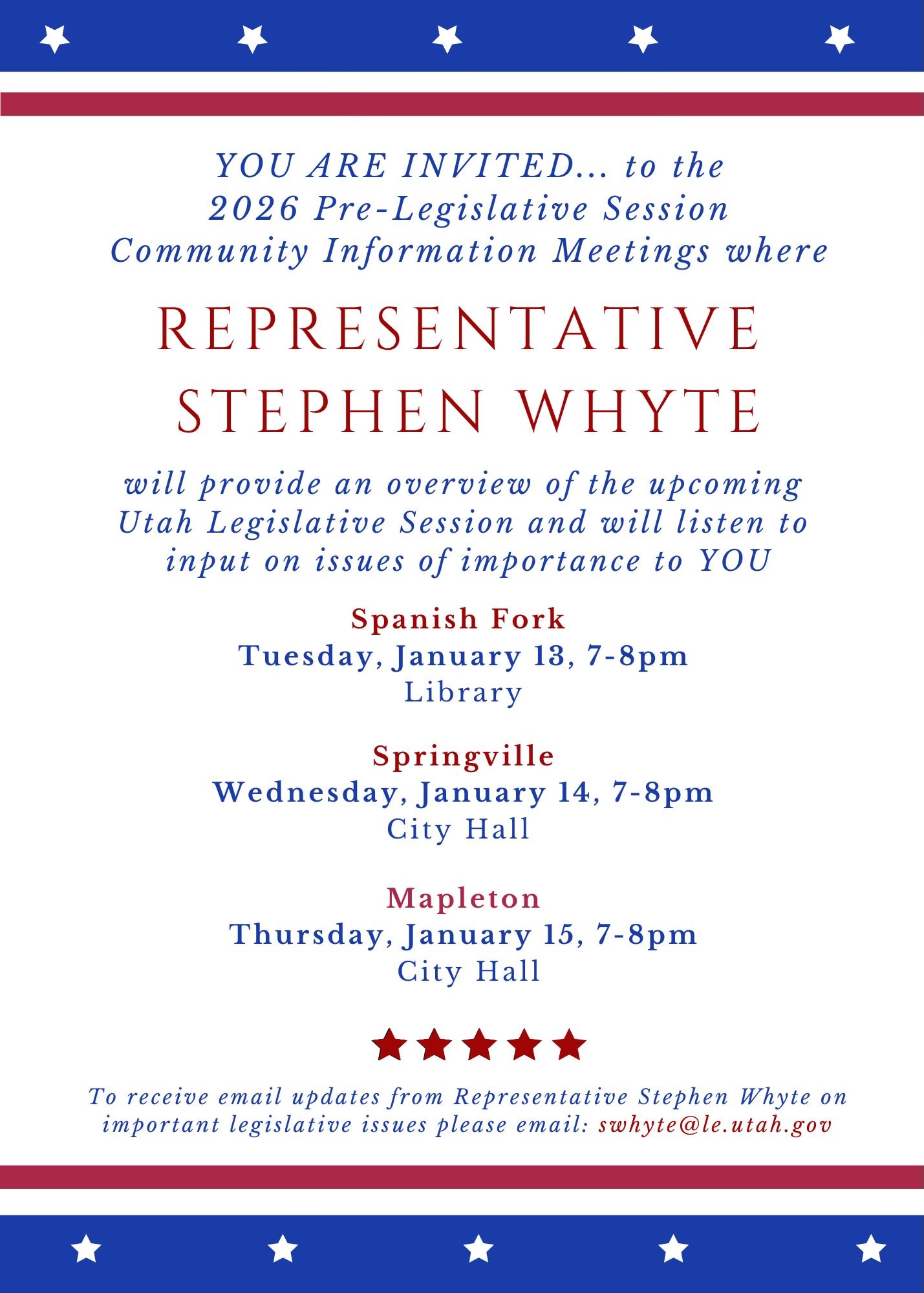
You’re Invited: Pre-Legislative Session Community Info Meetings
|
Residents of House District 63 in Mapleton, Springville and Spanish Fork are invited to my 2026 Pre-Legislative Session Community Information Meetings. I will provide an overview of the upcoming Utah Legislative Session and will listen to your input on issues of importance to YOU!
Here are the details for each of the meetings. Please come to the one that is most convenient for you.
|
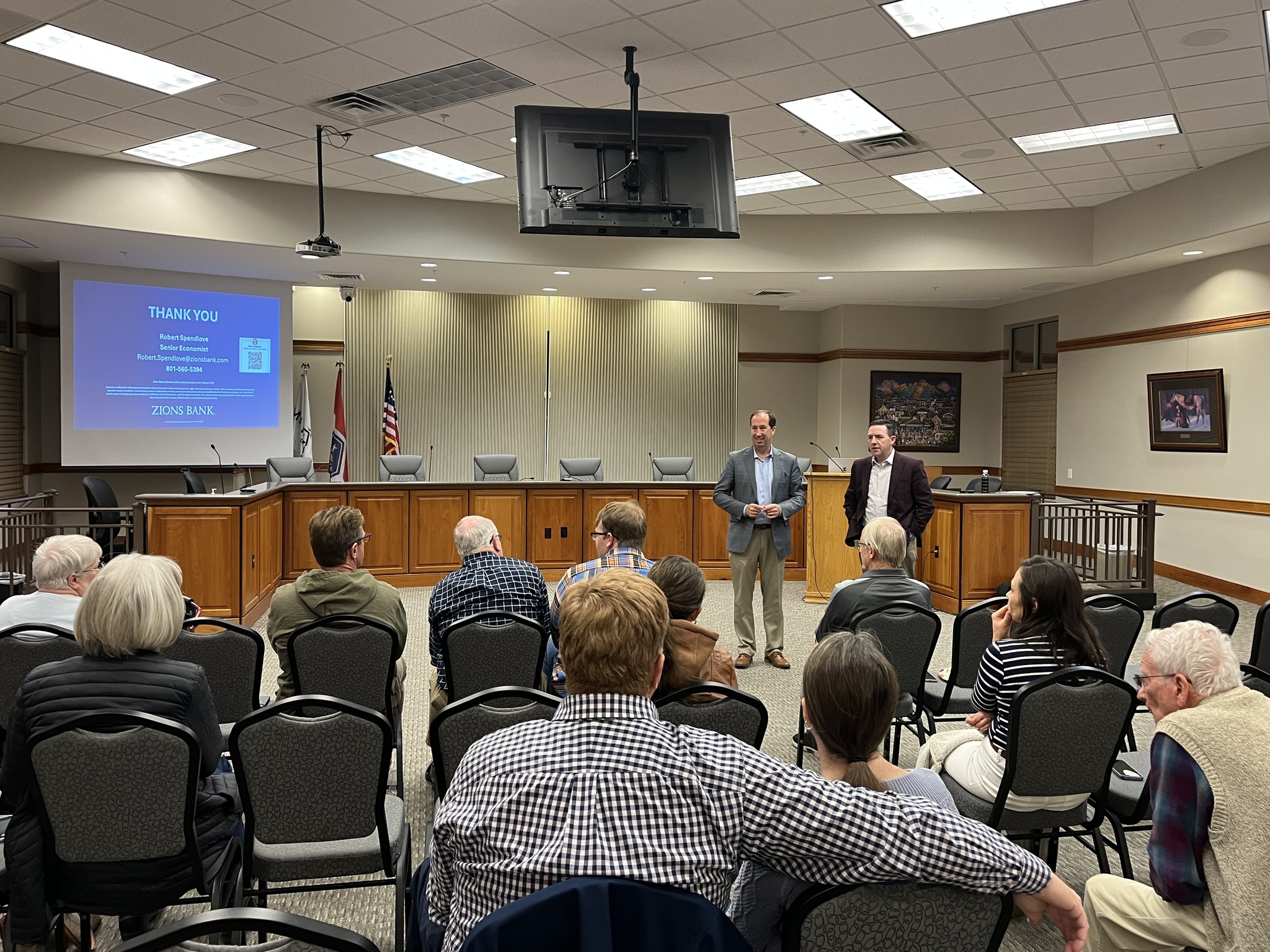
Thank you to everyone who attended my October Town Hall. With the state and national economy on our minds, I planned this Town Hall to provide updates about the economy, interest rates, inflation, national debt, and impact of federal decisions. A big shout out of thanks to our special guest Robert Spendlove, Senior Economist for Zions Bank, for his informative and compelling presentation.
|
|
The “Whyte House” went to The White House
|
The “Whyte House” went to the “White House” to represent and discuss issues important to our local community. Building bridges of understanding, collaboratively working together, and making our country and state better IS happening and I’m grateful for the White House’s interest, listening ear, responsiveness, and willingness to solve problems.
|
|
Farmers and Ranchers Feeding Utah and the World
|
Farming, ranching, and agriculture are economic pillars in the state, providing more than 44,000 jobs and products contributing over $2 billion to Utah’s GDP. From beef, dairy, sheep to fruits and vegetables, Utah’s farmers are feeding Utah and the world. Thank you Farm Bureau for the honor of being with you at the state convention. As a boy who grew up on a family farm, you have my full support.
|
|
Education: Meeting with Students, Superintendents, Teachers Throughout Utah
|
As I serve as the House Chair of the Public Education Appropriations Committee, I’m traveling the state meeting with teachers, students, and superintendents listening to their recommendations, which I love and appreciate.
Meeting with all the public-school Superintendents throughout Utah this month was very helpful as we plan for the upcoming 2026 Legislative Session. They are a united, strong voice for education to help students excel, advocate for teachers, reduce burdens, and expand opportunities. It is an honor to collaboratively work with them.
|
Spending time with Carbon School District leaders, teachers, and students was both fantastic and inspiring. The spirit of camaraderie, community, and teamwork was felt at Carbon High School, Mont Harmon Middle School, Castle Heights Elementary, and Castle Valley Center. I loved their foresight, creativity, and innovation in helping students succeed. A big shout-out of thanks to Superintendent Mika Salas, Assistant Superintendent Stacy Basinger, Principals Hardy, Palmer, Fluckey, and Bell, Mr. Lasslo—who has taught for more than 50 years—and all the incredible teachers and employees.
|
|
November Interim Meetings
|
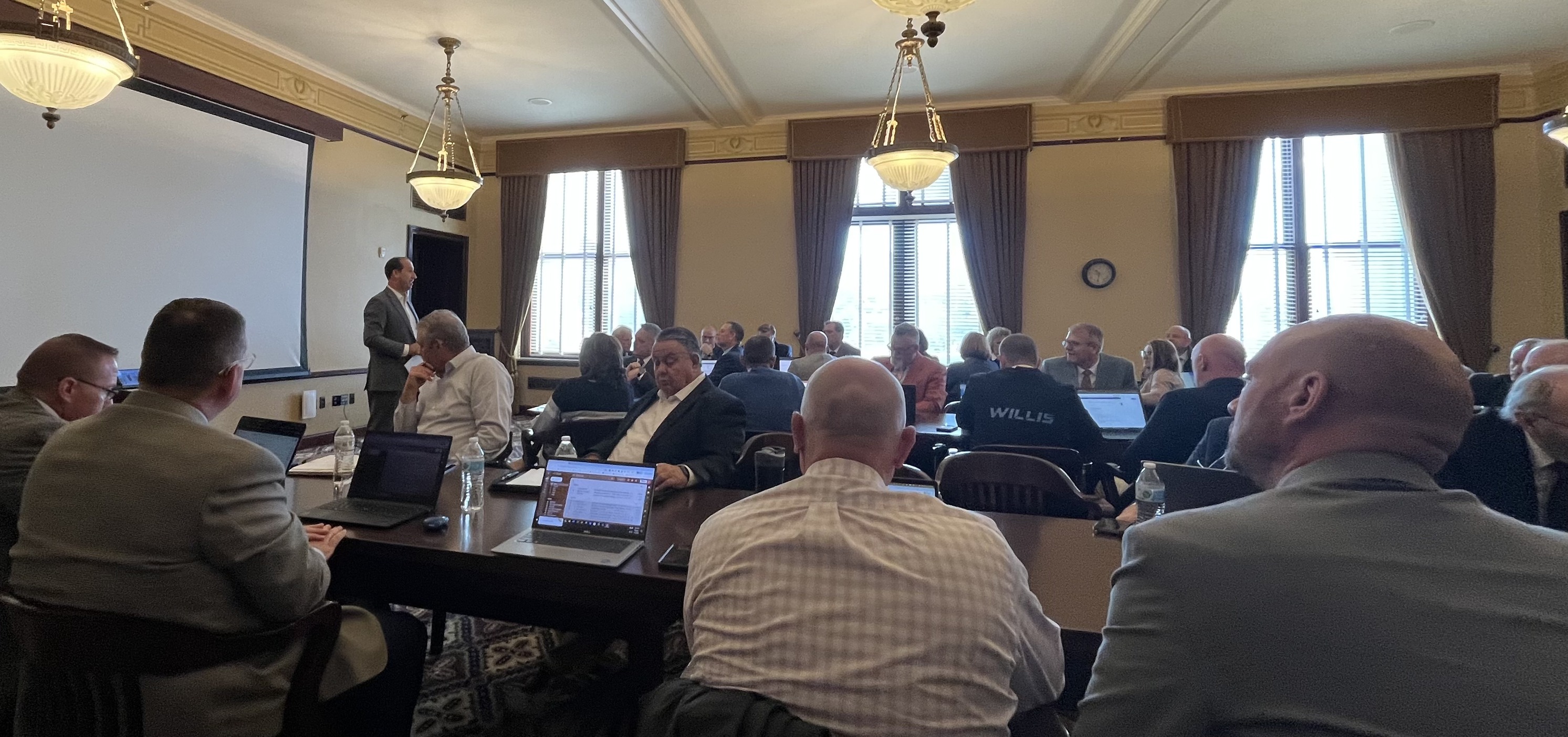
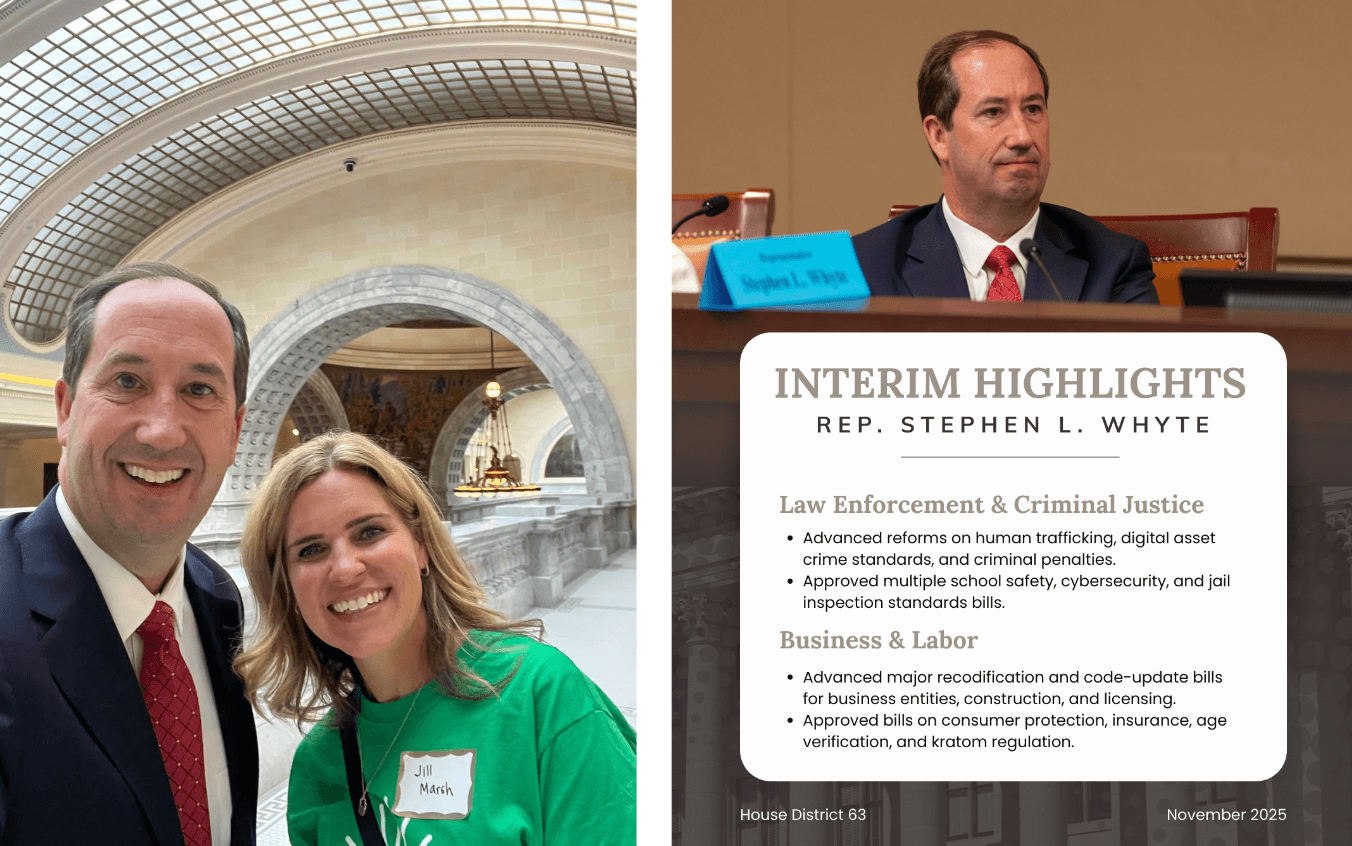
November’s interim legislative meetings at the Capitol worked on hundreds of issues to help families, address today’s problems, and to plan for the future. I love and appreciate when neighbors and friends from our House District are involved. This is truly a team effort involving everyone in the state. Interim meeting outcomes can be found here. You can also watch the full recordings of the meetings at le.utah.gov.
|
A few items of note from the November interim legislative meetings in relation to recommendations you’ve given me and to questions I’ve received from you in our House District:
Kratom:
- A Business and Labor Committee bill will move forward “Kratom Revisions” which would schedule 7-hydroxymitragynine, including synthetics, as a schedule 1 controlled substance under certain conditions.
- A Health and Human Services bill will move forward “Kratom Adjustments” which would repeal the Kratom Consumer Protection Act and schedule alkaloids found in or derived from kratom as schedule 1 controlled subtances.
Housing:
- In the 2025 Legislative Session, I ran a resolution, which was signed by the House of Representatives, Senate, and Governor, to streamline government, eliminate duplication and consolidate bureaucracies so the state can make better data driven solutions to help make housing more affordable. A bill “Housing Amendments” will move forward in the 2026 Legislative Session to make these changes.
Property Tax Relief:
Vehicle Registration:
- A Transportation committee bill will move forward “Vehicle Registration Amendments” which would allow for a pro-rated refund of an unused portion of a vehicle registration period.
|
|
Utah: 2nd Lowest State Debt In the Nation
|
Thanks to years of disciplined, forward-looking planning and strong leadership, Utah has the 2nd-lowest state debt in the nation and is on track to be completely debt-free. Since 2021, the Legislature has reduced 66% of the state’s debt, keeping government spending under control. This fiscal responsibility puts more of Utahns’ hard-earned money back in their pockets. Paying off debt saves money, which means more money returned to taxpayers. We’ve cut taxes for the past five years. Read more here.
|
|
Supporting Utah’s Firefighters
|
This year, the Legislature took major steps to protect the health and safety of Utah’s firefighters. With the passage of H.B. 65, we expanded free cancer screenings and medical coverage for firefighters and funded the new Rocky Mountain Firefighter Cancer Clinic—a first-of-its-kind program that will save lives. Firefighters face significantly higher cancer risks because of their service, and this bill ensures they have access to early detection and specialized care. It also expands the list of cancers presumed to be job-related, helping firefighters and their families receive the benefits they deserve. Utah is proud to stand behind those who stand ready to protect us every day.
|
|
Lowering Gas Prices for Utah Families
|
Utahns shouldn’t be paying more at the pump than our neighbors — especially when we’re home to five refineries that produce about one and a half times the fuel we use. The Legislature is taking a close look at why prices remain high and exploring solutions to make fuel more affordable for Utah families. Our goal is simple: keep energy reliable and affordable, protect Utah jobs, and ensure the benefits of our strong energy industry stay with the people who live and work here.
|
|
Standing Up for Fairness in Girls’ Sports
|
Utah has reaffirmed a simple but important principle: girls’ sports are for girls. The lawsuit challenging our law (H.B. 11 passed in 2022) that keeps boys from competing in girls’ sports has officially been dropped. With this challenge behind us, Utah’s common sense protections for fairness and safety in school athletics remain in place. I’m proud that we stood firm to ensure our girls can compete on a level playing field—one that honors their hard work, talent, and opportunity.
|
|
Investing in Utah’s Students and Workforce
|
This year, the Legislature took bold steps to strengthen Utah’s higher education system through HB265 Higher Education Strategic Reinvestment Plan — a reform that’s already making a real difference. Under this plan, colleges and universities are redirecting resources toward high-demand fields like health care, engineering, artificial intelligence, and technology. These investments ensure that Utah students graduate with the skills our economy needs while keeping higher education affordable and accessible. By aligning academic programs with real-world opportunities, we’re preparing the next generation to thrive — and making sure every taxpayer dollar works harder for Utah’s future.
|
|
Redistricting Utah’s Congressional Boundaries:
|
I appreciate the many people in our local neighborhoods who have reached out to me with concerns regarding the redistricting process and the November developments of this multi-year issue. The question I’m typically asked is “what is happening and how did we get to the current problem?” Below is the update I shared after the October Special Legislative Session which answers these questions.
November developments: Since Judge Gibson picked a Congressional Map on November 10, additional problems and concerns have arisen with her selected map, the process in which this map was created, and how it did not follow Prop 4. As a result, Governor Cox is calling the Legislature into a Special Session on December 9 at the Capitol to ensure the state’s election system has the clarity it needs. Specifically, 1) Judge Gibson’s November 10 ruling will be appealed to the Utah Supreme Court, 2) a state constitutional amendment will be proposed for the November 2026 ballot which all Utahns will vote upon.
The Underlying Issue: The Utah Constitution (Article IX, Section 1: Apportionment and Districting) reads: “The Legislature shall apportion the state into senate and house districts and into congressional districts according to the number of inhabitants, as shown by the federal census. The Legislature may alter the boundaries of districts and apportion representation as provided by law.”
These two sentences in the Utah Constitution are being interpreted in different ways by different people and organizations. The underlying issues we’re facing today are the same issues the Founding Father’s of our nation and state debated and resolved: rule of law, separation of powers, checks and balances, and a representative republic vs a direct democracy. I’m optimistically confident that as a state, we will continue to uphold our Constitution and it’s proven values and principles that have stood the test of time.
|
|
Voting Rationale:
October 6, 2025, Special Session
|
Redistricting Utah’s Congressional Boundaries
Over the past month there has been a lot of interest, media coverage, and social media chatter about Utah’s Congressional boundaries and the realignment process of creating Utah’s four Congressional maps. As I have spent a significant amount of time with these issues, I’ve been asked many questions and I’ve noticed there is confusion, misinformation, incomplete stories, and false “facts” being circulated about redistricting. To help bring clarity to this issue, I will begin by sharing the real facts, explaining the process, answering questions, and then explaining my vote.
Facts:
- Every ten years a federal census is taken throughout the nation, and in Utah, per the United States Constitution (Article 1, Section 2). The last census was conducted in 2020, and the census results were released in April 2020.
- Utah’s population number per the census was 3,271,616, which is the official number to be used for creating maps.
- Following federal law and based upon Utah’s population, Utah is allotted four U.S. Congressional seats.
- After the census numbers were released, the boundaries of the four Utah Congressional districts were created.
- In the following the federal redistricting laws, the Voting Rights Act requires equal population in each Congressional district. The four Utah Congressional districts ideal target population is 817,904 people per district (total population of 3,271,616 divided by four districts),
- The Utah Constitution (Article IX, Section 1: Apportionment and Districting) reads: “The Legislature shall apportion the state into senate and house districts and into congressional districts according to the number of inhabitants, as shown by the federal census. The Legislature may alter the boundaries of districts and apportion representation as provide by law.”
What is Proposition 4 (Prop 4) and how is it involved with Utah’s Congressional boundaries?
- Utah Proposition 4 (in 2018) titled “Independent Advisory Redistricting Commission Initiative” was a citizen initiative designed to change how Utah’s congressional, legislative, and school board district boundaries are drawn after each census by creating an independent redistricting commission to recommend maps to the Legislature.
- On November 6, 2018, Utah voters approved Proposition 4 by a razor-thin margin (50.34% to 49.66%). It was backed by a grassroots group Better Boundaries Utah.
- Because Prop 4 passed, it became law and a 7-member Independent Redistricting Commission was created to propose maps to the Legislature after each census.
What is SB200?
- In March 2020 before redistricting began, to ensure alignment with the Utah Constitution which states the Legislature has the sole constitutional authority to decide congressional boundaries (Article IX, Section 1), the Legislature passed SB200 which clarified that the Independent Redistricting Commission was advisory to the Legislature rather than binding.
How the 2021 Congressional district boundaries were created:
- Following the 2021 redistricting process outlined here, the Utah Legislature (Legislative Redistricting Committee) spent months traveling the state and holding 19 public meetings to gather input from the public to create maps.
- The Independent Redistricting Commission also held public meetings throughout the state to create maps, which the Commission presented to the Legislature.
- The Legislature, after evaluating all the proposed maps, made a final decision and adopted the four new Congressional maps on November 12, 2021.
Lawsuits:
- In March 2022, Better Boundaries, the League of Women Voters, and Mormon Women for Ethical Government sued arguing that the Legislature violated the people’s right to pass initiatives and that gerrymandered maps violated Utah’s constitution. The lawsuit only challenged the state’s four Congressional seats not the boundaries for the state legislative districts or school board districts.
- The Utah Supreme Court heard arguments in July 2023 and ruled in July 2024 that the lawsuit could proceed, confirming voters have a constitutional right to enact laws like Proposition 4.
- On August 25, 2025, Utah’s Third District Court Judge Dianna Gibson ruled 1) the Legislature overstepped when it adjusted the 2018 ballot initiative creating an independent redistricting commission, 2) ordered lawmakers to draw new congressional maps in time for the 2026 election, 3) comply with a set of specific standards in Prop 4 to create new congressional maps, and 4) wrote, “Given the general, non-specific nature of the language, the Legislature retains discretion in determining what judicial standards are applicable and they retain discretion to determine the ‘best available data and scientific and statistical methods’ to use in evaluating redistricting plans for compliance with state and federal law and the Proposition 4 redistricting.”
How the new Congressional maps are to be created:
- Redistricting requirements and standards required by law, per Prop 4:
- The Legislature and the Commission may not divide districts in a manner that purposefully or unduly favors or disfavors any incumbent, elected official, candidate or prospective candidate for elective office, or any political party.
- Prop 4 requires that maps abide by the following redistricting standards to the greatest extent practicable and in the following order of priority:
- Population deviation
- Minimizing the division of municipalities and counties
- Compactness, contiguity, and ease of transportation
- Preserving neighborhoods and communities of interest
- Following natural geography and boundaries
- Maximizing alignment across different types of districts
- The Legislature and Commission shall use judicial standards and the best available data and scientific and statistical methods, including measures of partisan symmetry, to assess whether a proposed redistricting plan abides by and conforms to the redistricting standards.
- Partisan political data and information, such as partisan election results, voting records, political party affiliation information, and residential addresses of incumbent elected officials and candidates or prospective candidates for elective office, may not be considered by the Legislature or by the Commission.
What standards, best available data and scientific and statistical methods should be used to create congressional maps?
- Partisan symmetry means both major political parties should have an equal chance to win seats with the same share of the vote.
- The Partisan Bias Test is the method used to measure partisan symmetry. It evaluates whether district lines give one party an advantage the other would not enjoy with the same level of voter support. The test:
- Equalizes votes to see if both parties would have the same opportunity to win.
- Identifies unfair practices like packing (concentrating one group into a single district to dilute influence elsewhere) or cracking (splitting a group across districts to weaken its voting power).
- Uses hypothetical elections, not actual results, to detect bias built into the map.
- Judge Gibson noted that the language of Proposition 4 was “general” and “non-specific” and invited the legislature to determine “what judicial standards are applicable” and to “determine the best available data and scientific and statistical methods to use in evaluating redistricting plans for compliance with Proposition 4.” (see Judge’s order, pages 29-30).
- Judge Gibson’s critique of Proposition 4 provides guidance for the Legislature in establishing clear judicial standards for courts to apply when reviewing maps.
- In short, both the Legislature and the Independent Redistricting Commission should be able to determine upfront whether their maps comply with Proposition 4, rather than waiting for each map to be litigated.
- You can watch a full explanation of the partisan symmetry policy and tests by clicking here.
What is the Partisan Symmetry Bill and why does it matter?
- The bill SB1011 Redistricting Standards, voted on in the October 6, 2025 Special Session, sets up three tests to be used as the standard and method moving forward to create congressional maps. The three tests are:
- Partisan symmetry test (explained above)
- Mean medium test (tests the vote distribution)
- Ensemble test (tests the overall fairness of distribution of the two other tests)
- The bill ensures fairness by providing a pass/fail measure based on whether a map meets partisan symmetry.
- The bill gives immediate clarity of those submitting maps, rather than waiting for court rulings.
- The bill helps prevent ongoing legal disputes and confusion by giving judges a clear method to apply.
- The bill ensures transparency and consistency in redistricting, protecting against drawn-out lawsuits.
- The bill creates an objective and consistent baseline for assessing maps.
Are there additional requirements the Legislature is following or considering when preparing the congressional maps?
- After Proposition 4 requirements have been met, the Legislative Redistricting Committee has determined additional key preferences that reflect Utah’s unique needs in each congressional district to include:
- Rural and urban balance
- Military installations
- Institutions of higher education
- Percentage of federal lands
Why rural and urban areas?
- The Legislature’s goal is to ensure that every Utahn, whether from a small farming town, a rural community or an urban area, has a strong voice in Congress. Farmers, ranchers, city workers and business owners deserve equal representation in Washington.
- The Legislature believes each member of Congress should serve both rural and urban communities. Utah is strongest when every voice—whether from Main Street or a family ranch—is heard and represented.
- It’s also important that each member of Congress represent and understand federal lands, rural healthcare access, and water resources.
Was partisan data used to create the maps?
- No. Under current law, the Legislature is prohibited from considering partisan political data or information in connection with redistricting.
- In compliance with both the court’s order and Proposition 4, the Legislature is taking every step to avoid any reference to, or use of, partisan data. This means the Legislature cannot look at election results, voting records, party affiliations or information about incumbents or prospective candidates when reviewing maps.
- For that reason, and out of an abundance of caution, the Legislature has not and will not review or consider partisan political data. This ensures the Legislature remains in compliance with the law and the constitutional requirements that no map may favor or disfavor any political party or candidate.
Is creating new Congressional maps in Utah connected to what Texas, California and other states are doing to intentionally gerrymander their Congressional maps?
- No. Utah’s situation has been tied up in the Courts for many years and the timing of Judge Gibson’s decision, ironically and coincidentally, was released near the same time Texas, California and other states are intentionally gerrymandering their Congressional districts.
Why doesn’t the Legislature just adopt an Independent Redistricting Commission (IRC) map from 2021?
- The court’s order specifically says that the Legislature cannot use IRC maps as they were established under SB200.
- Additionally, the IRC maps do not meet the requirements of Proposition 4.
What new maps were presented?
- All committee maps and maps submitted by the public are online here.
- The maps, which are accessible online, can be viewed here:
- An independent analysis of all six maps can be found here: https://le.utah.gov/interim/2025/pdf/00003667.pdf
- On September 23, The Salt Lake Tribune newspaper wrote, “All five of the congressional maps proposed by Utah’s Legislative Redistricting Committee include at least one competitive seat, according to an analysis of recent voting data by The Salt Lake Tribune. While the vast majority of the seats favor Republicans, which is to be expected in a conservative state, each of the newly proposed maps would give a strong Democratic candidate a fighting chance.”
How can people comment on a map?
- In following Judge Gibson’s ruling, only a 10-day period was granted for Utahns to provide comments.
- Although not required, the Legislature held two public meetings to give citizens an opportunity to provide comments.
- Public comments were open for any Utahn between September 25 and October 5.
- Public comments can be viewed here: https://redistricting.utah.gov/2025-legislative-redistricting/
Why must the Congressional maps be created within a timeline that feels rushed?
- The Lieutenant Governor’s Office, who has oversight of state elections, must receive the updated Congressional maps by November 10 in order to be prepared for the election process next year and give country clerks around the state enough time to prepare for the 2026 midterm elections.
- Judge Gibson gave the legislature 30 days to come up with new maps or the Judge would create the maps.
- The Legislature appealed the timeframe to the Utah Supreme Court to provide more time for meaningful statewide input and involvement, but the Utah Supreme Court denied the appeal.
- The Judge, having had this case since July 2024, could have ruled on this case at any point over the past year but instead released the decision in August 2025. See timeline here.
Why are some cities being split between Congressional districts?
- Prop 4 requires maps to minimize the division of municipalities and counties.
- The ideal population number for each Congressional district is 817,905 (Utah population 3,271,616 divided by four districts)
- The state has four cities that have boundaries that extend across county boundaries:
- Bluffdale (Salt Lake and Utah Counties)
- Draper (Salt Lake and Utah Counties)
- Park City (Summit and Wasatch Counties)
- Santaquin (Juab and Utah Counties)
- While trying to minimize the division of cities and counties, a few cities will likely need to be split between two Congressional districts to achieve the target/ideal population headcount in each district.
Why is Salt Lake County being split between Congressional districts?
- The population of Salt Lake County is 1,185,238.
- Each Congressional district’s headcount is 817,905.
- As a result Salt Lake County cannot fit within just one Congressional district and must be divided.
What happened on October 6 and what are the next steps?
- On October 6, the following happened:
- the Legislative Redistricting Committee met to vote on a recommended map to present to the full Legislature. The Committee recommended map Map C.
- the Legislature met in a Special Session and voted on SB1011 Redistricting Standards. This was passed by the Legislature and signed into law by the Governor.
- the Legislature voted on the recommended map.
- Going forward:
- The voted-on map will be given to Judge Gibson.
- Oct. 17: Parties file briefs, expert reports, and other materials in support of respective map submissions and in opposition to any map submissions, if necessary.
- Oct. 23-24: Evidentiary hearing, if necessary.
- Oct. 28: Parties file proposed findings of fact and conclusions of law with the court, if necessary.
- The final map has to be chosen by November 10 by the Judge.
My personal analysis:
- The Utah Constitution (Article IX, Section 1: Apportionment and Districting) reads: “The Legislature shall apportion the state into senate and house districts and into congressional districts according to the number of inhabitants, as shown by the federal census. The Legislature may alter the boundaries of districts and apportion representation as provide by law.”
- These two sentences in the Utah Constitution are being interpreted in different ways by different people and organizations.
- My interpretation of these two sentences is that the Legislature has the sole constitutional authority to decide congressional boundaries.
- Having a court or a judge make the final decision on congressional maps is not following the Utah Constitution.
- The Legislature has proposed a new congressional map that follows the requirements of Prop 4.
My voting rationale:
- I voted in support of the new Congressional map “C” per SB1012 Congressional Boundaries Designation and I voted in support of SB1011 Redistricting Standards based upon the facts and details provided above.
|
I would love to hear from you!
|
District 63
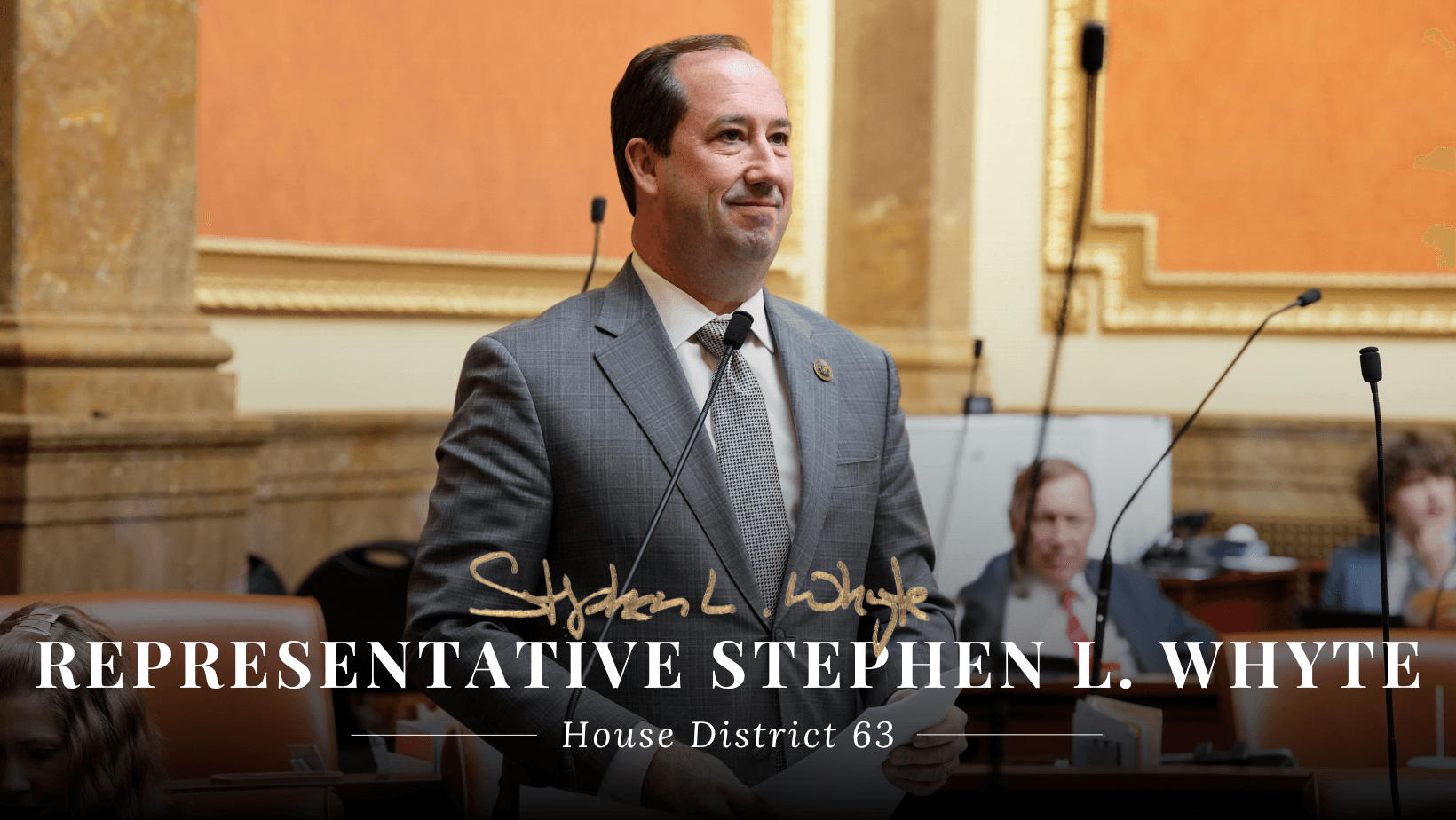
Representative Stephen L. Whyte
swhyte@le.utah.gov
385-271-8435
|
|

.png)
.png)
.png)
.png)

.png)
.png)
.png)
.png)
.png)