|
|
|
|
Dear Neighbor:
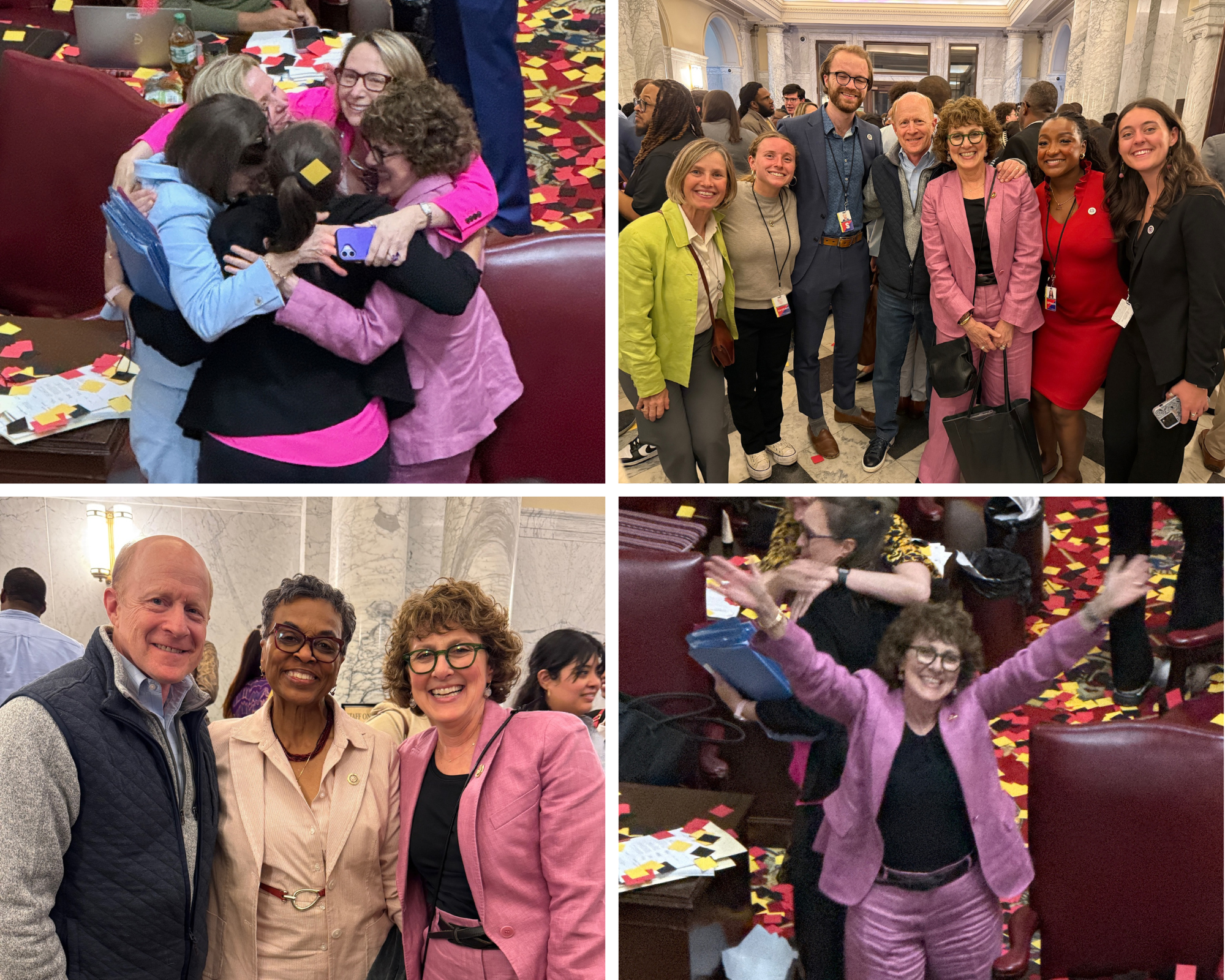
The Maryland General Assembly (MGA) concluded its 449th Legislative Session on April 13, after 90 days defined by protecting our residents from the Trump Administration's chaos while continuing to make generational investments in Maryland families and our State’s future. Decisions coming from Washington are reshaping long-standing assumptions about economic stability and governance, with direct consequences for our State.
At the start of the 2026 Legislative Session, the Senate of Maryland announced a focused agenda to:
The Senate took deliberate action to advance policies addressing a wide range of priorities. We took steps to protect civil liberties and stop abuses by Immigration and Customs Enforcement (ICE). We supported working families, improved public safety, and expanded opportunity in education and the workforce. And we addressed emerging challenges, such as data privacy and the use of artificial intelligence, all while investing in an economy rooted in 21st century technologies with the potential to increase prosperity for everyday families.
Each bill passed and awaiting the Governor’s signature reflects our commitment to delivering results that meet the demands of this moment, while positioning Maryland for what lies ahead. We made clear that Maryland would respond where necessary to protect our communities and uphold the values that define our State.
Throughout it all, we remained focused on delivering results for the Marylanders. Now, with the 2026 Session behind us, I look forward to continuing my work alongside you in District 11. |
|
|
|
|
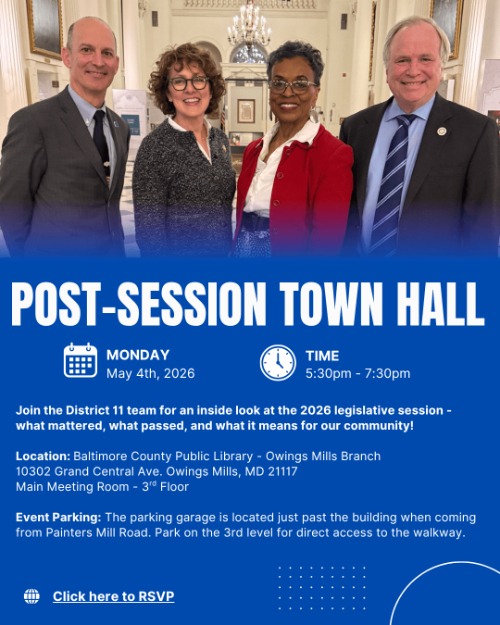
Join me and our entire District 11 Team, Delegates Jon Cardin, Cheryl Pasteur, & Dana Stein for a post-session Town Hall on Monday, May 4th! Now that the legislative session has wrapped up, we’re looking forward to connecting with you, discussing important issues, and answering your questions. The town hall will include an overview of key legislation, followed by a Q&A where we’ll address your questions and concerns.
RSVP here
|
|
|
|
Below is an overview of key measures and legislative priorities the MGA addressed during the 2026 Legislative Session:
Protecting Marylanders from Unconstitutional and Lawless Federal Enforcement: Public safety is dependent on trust between our neighbors and local law enforcement. The Trump Administration and ICE are engaging in unconstitutional and illegal actions in Maryland and across the country, engaging in a campaign meant to instill terror in immigrant communities. Those federal activities are an attack on Maryland values, and the MGA passed several bills to put a check on that lawlessness. In one of the first acts of Session, the MGA passed SB245 to immediately prohibit formal 287(g) agreements between local jurisdictions and federal immigration authorities, enabling law enforcement to stay focused on local community safety priorities and maintain trust within the communities they serve. Second, after local sheriffs publicly stated they would disobey that law, we advanced the Community Trust Act (SB791) to end informal cooperation between State and local officials and ICE until constitutionally guaranteed due process protections occur in our criminal justice system.
Through SB1, we banned the use of face coverings during routine law enforcement activities, increasing transparency so residents know who is exercising authority in their neighborhoods. Further, to prevent misuse of personal information and undermining of basic privacy protections, the MGA passed the Data Privacy Act (HB711) to restrict the use and sale of personal data for immigration enforcement purposes. Additionally, the MGA outlawed ICE from building or operating detention facilities in Maryland unless a local government explicitly zones the area for that purpose through HB1017, thereby preventing the inhumane conditions at existing facilities from expanding throughout our State.
We also addressed how immigration enforcement intersects with essential institutions through SB792, which requires hospitals to implement clear protocols and train staff on how to respond to enforcement actions, as well as through the Maryland Values Act of 2026 (SB810), which strengthens protections in schools, courthouses, and other sensitive locations.
Ensuring Accountability for Civil Liberties Violations: Marylanders deserve clear remedies in instances where federal officials violate their basic and fundamentally guaranteed constitutional rights. When these breaches of the public trust occur, there must be recourse to hold officials accountable under the law. The No Kings Act (SB346) establishes a civil cause of action when individuals are deprived of constitutional rights under color of law, reinforcing necessary consequences and affirming that no individual stands above the law.
Holding Utility Companies Accountable and Lowering Energy Bills: Marylanders are continuing to reel from unacceptably high energy bills as data center growth pulls from existing supply and utility companies put profits ahead of the people they serve. Maryland families are facing impossible choices between paying their utility bills and keeping food on the table, and it was paramount that the MGA build on the historic progress from last year’s energy package through the Utility RELIEF Act (HB1532). That comprehensive legislation provides immediate financial assistance and further protects Marylanders from future increases in areas within the State’s control. Specifically, the Utility RELIEF Act:
Altogether, the Utility RELIEF Act represents one of the most aggressive and comprehensive energy affordability efforts for Marylanders in a generation.
Increasing the Availability of Affordable Housing to Reduce Costs: Access to safe and affordable housing remains one of the most pressing challenges facing Maryland families, and we took numerous actions to increase its availability and streamline construction. The Maryland Housing Certainty Act (SB325) provides clear, predictable standards so approved developments can move forward without local jurisdictions shifting requirements after a project application was submitted. It also adjusts when local development fees are collected, reducing the costs that are passed onto renters and buyers. The Bring Back Main Street Act (SB829) puts Maryland on the path of further encouraging multi-family housing and mixed-use development throughout commercial corridors. Finally, the Fair Chance Housing Act (SB937) expands access to housing by limiting how past conduct can be used in tenant screenings by landlords with five or more units.
Prohibiting Dynamic and Predatory Pricing: Marylanders deserve relief, not surprises, when shopping or paying bills. As families struggle to afford the basics, the MGA promoted transparency, and prohibited the use of practices that raise everyday costs. Through the Protection from Predatory Pricing Act (HB895), we acted to ensure fairness at checkout. That legislation requires prices to remain fixed for at least one business day so large corporations can’t manipulate prices. The legislation also bans using surveillance data — information from a consumer’s behavior or characteristics — to set individualized prices. These actions will prevent technologies like electronic shelf labels from allowing surge pricing that unfairly raises costs.
Modernizing Maryland’s Economy: Our State is at a critical crossroads where we can no longer rely on a federal government workforce and contractors to support our local economies. It is critical that we diversify our economic assets and capitalize on industries of the future, like aerospace where we rank first in the nation for our concentration of aerospace engineers. Looking ahead, the Maryland Future Fund (SB770) establishes a long-term vision for economic growth by bringing together leaders from the business community, labor, academia, and the nonprofit sector to chart a more equitable and prosperous path. At the same time, the Advanced Manufacturing Grant Program (SB905) will invest in emerging, high-skill industries like regenerative medicine, ensuring Maryland remains a leader in innovation while expanding job opportunities and strengthening workforce alignment. Maryland cannot afford to be complacent as we seek to attract technology industries of the future, which we are uniquely positioned to grow. The Delivering Economic Competitiveness and Advancing Development Efforts (DECADE) Act (SB388) builds on this momentum by modernizing Maryland’s economic development strategy, strengthening key industries, and maximizing the return on State investments to attract private capital.
Supporting Small and Local Businesses: Maryland’s main streets, neighborhood business centers, and retail corridors are the lifeblood of the State’s economy and the source of countless employment opportunities for our residents. Over 97% of Maryland businesses are considered small businesses according to the Small Business Administration. To support small businesses is to support the entire economic health of our State. The MGA passed SB767 to establish the Main Street Small Business Property Tax Credit program so local governments can deliver targeted relief to small businesses. Further, the Small Business Access to Capital Act (SB920) removes barriers for entrepreneurs by improving access to funding while maintaining strong oversight, ensuring that businesses have both the resources and support they need to grow and succeed. Finally, SB757 requires the Department of Commerce to create an online Maryland Local Sourcing Portal to connect businesses in the State with local suppliers as a mechanism to support local economies while avoiding paying exorbitant federal tariffs.
Incentivizing Smart Development and Revitalization: For our State’s economy to grow, we must target State and local level incentives strategically. As families face increasing costs that make it difficult to get by, critical projects are facing the same pinch caused by tariffs and increased costs at every step of development. Through the Maryland Transit and Housing Opportunity Act (HB894), we are making it easier for transit-oriented development to be built in the areas where it is most needed. This reform will make it easier for Marylanders to access mass transit and revitalize prime areas of the State. Further, SB756 establishes a payment in lieu of taxes for economic development in the Downtown Business District in Baltimore City, subject to local approval, to support revitalization efforts, including activating vacant spaces and strengthening small businesses.
Strengthening Unions and Maryland’s Middle Class: Maryland remains firmly committed to supporting those who serve the public good by advancing policies that protect workers, promote fairness, and ensure stability as our State grows. As the Trump Administration and efforts through Project 2025 seek to dismantle union participation, the MGA stepped in to support organized labor, recognizing that worker participation is foundational to sustaining a thriving middle class. We comprehensively addressed labor rights this year by:
Balancing the State’s Budget While Investing in Maryland Values: The MGA passed the State’s Fiscal Year 2027 (FY27) Operating Budget (SB282), alongside the Budget Reconciliation and Financing Act (SB284), fulfilling our constitutional responsibility to pass a balanced budget each year. The FY27 Operating Budget is the result of efficient collaboration between the Governor, House, and Senate that allowed the General Assembly to pass the budget earlier than in recent years. The budget meets affordability goals, reduces general fund spending, and preserves more than $2.4 billion in reserves, positioning the State to navigate ongoing fiscal pressures. We achieved these results without raising taxes or creating new fees. Our $71 billion FY27 Operating Budget includes:
Funding Our Local Economies and Anchor Institutions: The MGA invested a historic amount of capital funds to stimulate our local economies and provide Marylanders with family-sustaining jobs in the FY27 Capital Budget (SB283). That funding ensures vital support to our local institutions and invests State dollars in our community. This year’s Capital Budget directs resources to projects strengthening the foundation of our neighborhoods and supporting the institutions residents rely on every day. Through capital funding, workers and businesses gain new opportunities while investments in community spaces and essential infrastructure reinforce Maryland’s long-term stability. Projects funded in District 11 include:
Building World Class Public Schools for All Maryland Children: Maryland’s commitment to education is rooted in the belief that every child deserves access to world class public schools that prepare them to compete and thrive in a 21st century economy. This holds true regardless of zip code or background. We continued strengthening the Blueprint for Maryland’s Future through SB311, which invests in high-quality tutoring, makes it easier to recruit out-of-state teachers to reduce classroom sizes as we solve the educator workforce shortage, and ensures equitable access to dual enrollment courses. Further, the Maryland Phone-Free Schools Act (HB525) addresses the growing impact of technology on student learning and engagement. It mandates local school boards develop and enact thoughtful, community-informed policies to prohibit cell phone use throughout the school day, including during instructional time, lunch, and transitions. Finally, we took an important step to support students with disabilities and their families through Laila’s Elopement Awareness and Dissemination Act (SB745), which requires specialized training for law enforcement on how to respond to individuals with autism and other developmental disabilities should they elope from educational or other settings.
Expanding Access to Quality Child Care: Education begins well before a child enters a classroom and the first years of their life has an outsized impact on kids’ ability to succeed well into adulthood. Expanding access to affordable child care is foundational to creating a Maryland where every person has the tools to maximize their potential. Those core values encompass HB849 and HB1321, which reform Maryland’s Child Care Scholarship Program as the waitlist continues to grow. A $20 million funding increase prioritizes high-need families, caps copayments, and supports providers in growing their workforce. By working to lift enrollment barriers and reduce waitlists, we make it easier for thousands of Maryland families to access the child care they need so parents have the support they deserve.
Setting Students Up for Success in Post-Secondary Education: Continuing education after high school can take many forms, and an increasing number of jobs require a post-secondary degree or trade certification as a barrier to entry. Maryland is one of the most educated states in the country per capita, and must remain so while expanding opportunities for Marylanders for whom college is not the right next step. Congress recently authorized a Workforce Pell Grant to allow students to use federal grants for short-term, career-focused training programs. Through SB509, the MGA places common sense protections around the implementation of the program to align with our career readiness goals and ensure students aren’t taken advantage of by predatory actors. In addition, SB805 supports Maryland student loan borrowers who are caught in limbo as the Trump Administration dismantles the U.S. Department of Education and cannot change income driven repayment plans in a timely manner by creating a hardship waiver to delay repayment of the Maryland Student Loan Debt Relief Tax Credit. Moreover, residents who receive that tax credit will only need to repay unspent funds received from the State, instead of the entire tax credit if they receive more than was needed.
Enhancing Public Safety and Minimizing Gun Violence: The MGA advanced a series of bills aimed at addressing gun violence and emerging public safety threats in our State. We passed SB334, which prohibits the manufacture or sale of semi-automatic pistols that can easily be converted into machine guns with common household tools including Glock switches. Further, SB775 sets clear standards for gun buyback programs, including requirements for the safe handling and destruction of surrendered firearms. In addition, SB160 requires firearm dealers to report thefts, attempted burglaries, and compromised security measures within 24 hours, thereby improving coordination with law enforcement and increasing accountability in firearm regulation. These bills collectively confront risks tied to gun violence and prioritize safer communities.
Creating a Criminal Justice System Focused on Rehabilitation and Accountability: The legislature took meaningful steps to reform Maryland’s criminal justice system to take data driven approaches towards violence reduction and building sustainable community safety. The Youth Charging Reform Act (SB323) shifts more cases involving young people into the juvenile justice system, recognizing the importance of age-appropriate rehabilitation and reducing the number of children placed in adult facilities while maintaining neighborhood safety. Further, SB187 strengthens the State’s commitment to building a women’s pre-release center centered on ensuring parity in opportunities for returning citizens regardless of gender. These policies move Maryland toward a more balanced justice system that prioritizes rehabilitation as its core purpose.
Preempting the U.S. Supreme Court and Codifying a Maryland Voting Rights Act: Our democratic systems of election are under attack by the Trump Administration and Project 2025. The federal Voting Rights Act (VRA), landmark legislation passed in the wake of the civil rights movement, is systematically under attack as opponents seek to disenfranchise voters of color. In preparation for the United States Supreme Court gutting what is left of the VRA in the coming months, the General Assembly passed the Maryland Voting Rights Act of 2026 (SB255). The bill creates a State-level cause of action for judicial remedies should counties or municipalities dilute the votes of minority groups.
Leading on Regulating Artificial Intelligence: As artificial intelligence (AI) continues to scale rapidly, the MGA is examining how to both harness its potential and address its risks. Several bills we passed target specific concerns, including the use of deepfakes to cause harm and the protection of personal data collected through AI systems. Maryland will not ignore clear dangers facing our residents — particularly with fraud, misuse of personal data, deceptive practices, and identity impersonation. Specifically, the MGA advanced SB8 which criminalizes the use of AI and deepfake technology to perpetrate identity fraud and SB141 to prohibit political campaigns from deploying AI and deepfakes to distribute misinformation in our elections. Additionally, SB597 establishes an AI Partnership within our State institutions of higher education to ensure Maryland continues to be at the forefront of AI policy, while the AI Ready Schools Act (SB720) directs school districts to develop guidance around the use of AI in educational settings. These bills establish clear guardrails and position Maryland to responsibly integrate AI into critical areas of public life.
Bolstering Healthcare Despite Federal Attacks: This Session, Maryland’s healthcare system saw targeted policy changes to expand patient protections and support safe, reliable care. The Emergency Access to Abortion Act (SB169) guarantees patients receive medically necessary care in emergency situations by establishing clear standards for treatment and hospital responsibilities. With the Safe Staffing Act (SB411), hospitals must develop and implement staffing plans that better align with patient needs, improving both delivery of care and working conditions for health care professionals. The So Every Body Can Move Act (SB276) expands coverage for prosthetics and orthotics so individuals can access the mobility supports needed for daily life. SB521 updates notice requirements during insurance contract disputes while allowing patients to maintain continuity of care. Finally, the Vax Act (SB385) reinforces the use of evidence-based guidance for immunizations and preventative services, an approach that keeps public health grounded in science as federal guidance becomes rooted in politics and not sound policy.
Protecting Maryland’s Environment for Future Generations: Environmental challenges in Maryland demand a coordinated and proactive approach to protecting our land and waterways. The MGA addressed some of those challenges by passing SB719, which creates restrictions on the land application of sewage sludge containing harmful levels of per- and polyfluoroalkyl substances (PFAS), often referred to as “forever chemicals.” By improving oversight and setting enforceable standards, we can better protect Maryland’s natural resources and limit the spread of chemicals that can enter the water systems and pose risks to our residents. Moreover, we advanced SB599 to establish an On-Farm Organics Diversion and Recycling Grant Program to keep food and food waste out of landfills through the donation of produce that would otherwise be thrown away, and the composting of food scraps.
Responding to State Agency Audit Findings with Real Accountability: Responsible stewardship of public resources requires strong oversight and a commitment to addressing audit findings in a timely and effective manner. The MGA passed SB858 to create the Audit and Finance Compliance Unit within the Department of Budget and Management, establishing a centralized method for tracking, addressing, and preventing repeat audit finding within State agencies. This new unit will provide guidance and direct support to agencies, particularly those with persistent audit issues, and help implement systems to improve financial accountability and compliance. Trust in our governmental institutions starts with clarity that tax dollars are being spent as intended.
Looking After Our State’s Seniors: Protecting Maryland’s seniors and nursing home residents is a top priority every year as we promote connection, independence, and stability for older adults across the State. Through the Village Multigenerational Third Places Act (SB 530), we expanded investments in community spaces and initiatives that reduce isolation through grants for events in multigenerational spaces, where seniors build meaningful relationships. We also strengthened the infrastructure behind these aging-in-place services with SB860 by establishing the Aging Resilience Fund to support the Department of Aging’s mission through staffing, partnerships, and program development. By allowing resources for both programming and administration, the fund ensures a more responsive, sustainable care system.
In addition to working on many of the bills mentioned above, I introduced the following bills that were passed this session:
SB648/HB856 School Personnel Vetting and Hiring Transparency Act responding to an incident at a school in District 11, the bill advances student safety in Maryland by strengthening transparency and accountability in educator hiring practices. The bill requires every local education agency (LEA) to use the NASDTEC Educator Identification Clearinghouse in the process of hiring and reviewing educators. SB308/HB661 Muslim American Heritage and Jewish American Heritage Months recognizes the cultural contributions of both ethnic communities, requiring the Governor to proclaim January as Muslim American Heritage month and May as Jewish American Heritage month. SB805/HB1297 Income Tax - Student Loan Debt Relief Tax Credit adapts Maryland’s tax credit programs to protect student loan borrowers already reeling from the federal disorder of their loan repayment programs. (Mentioned above) SB530/HB811 Village Multigenerational Third Places Act enables the Department of Aging to make grants to nonprofit organizations and area agencies on aging to support social connections through multigenerational third places, defined as community spaces that support social connection, events, or gatherings among individuals of different ages. (Mentioned above) SB305/HB507 Incarcerated Individual Training and Reentry Grant Fund provides support for a reentry program for formerly incarcerated people in Maryland, allowing them to receive training as automotive technicians and pursue new job opportunities as they reenter their communities. SB369/HB571 Nonprofit Housing - Taxes and Special Assessments Exemptions enables certain nonprofit housing developers to obtain more certainty in the development process for affordable housing at a time when the need has never been greater. SB473/HB829 Human Trafficking Awareness and Prevention Training expands Maryland’s response to human trafficking by requiring awareness training for licensed taxicab drivers, for-hire drivers and transportation network drivers. SB340/HB671 Office of the Long-Term Care Ombudsman appropriates $2,000,000 per year to the Office of the Long-Term Care Ombudsman, an entity that advocates for the health, safety, well-being, and rights of residents in assisted living and nursing homes. SB253/HB388 BCPL - Collective Bargaining - Supervisory Employees grants BCPL supervisory employees the same rights to collective bargaining as other staff members, ensuring all voices are heard in organizational decisions. SB531/HB491 Victims of Sexually Assaultive Behavior - Verbal Waivers provides survivors of sexual assault with the power to make decisions about their own cases. Law enforcement may not use pressure, through any form of waiver, to discourage a survivor from pursuing a criminal investigation. SB649/HB969 Electric Vehicle - Requirements, Measure, and Fees provides consumer protections and information about prices, where to report downed service, for electric vehicle service equipment. If you would like to see my End of Session letter that was snail mailed, please click here. I was disappointed that we were not able to pass 2 important bills that I introduced this session. The first, SB20, would require courts to remove firearms from individuals in a protection order process earlier than they currently do. We know that when someone is attempting to involve law enforcement or make a change in a relationship where there is violence that it’s the most dangerous time for a victim. Second, we were very close to passing the Transportation and Climate Alignment Act (SB59/HB437), but ran into significant opposition on the Senate floor on the final day of session that would have ground our proceedings to a halt. This bill would require the Department of Transportation to be more thoughtful in its going-forward capital spending – doing an analysis of the transportation budget and large highway expansion projects for their contributions to greenhouse gases and vehicle miles travelled, and requiring offsetting projects over a period of time. We had a terrific team this session of two fellows, Marc and Corinne, who re-joined our office this year after serving in the 2025 session, a Johns Hopkins School of Public Health intern, Riziki, and a senior at Washington College, Ellie, who joined Janet, our Constituent Services liaison and Maura, our Chief of Staff. Our office hums with activity, helping constituents get their needs addressed from state agencies, and assisting with the legislative process.
I’m incredibly grateful for the opportunity to represent the 11th District in the Maryland State Senate. As always, please do not hesitate to reach out if we can be of assistance in any way.
Sincerely, |
|
|
Shelly L. Hettleman |
|
|
|
|
Unsubscribe from future updates |