|
|
Dear Friends and Neighbors,
Thank you to everyone who voted in this year's election. Whatever your choices on the ballot, taking part matters, and I'm grateful to live in a community that takes citizenship seriously. As we head into the 2027 General Session, here are a few issues I've been working on and thinking about. |
|
Strengthening Utah’s Energy Future |
|
Utah families and businesses have some of the most reliable and affordable electricity in the nation. In 2024 we had the lowest average residential rates in the country, and in 2026 we still rank second-lowest. That didn't happen by accident. It comes from a balanced mix of roughly 45% coal, 32% natural gas, and 22% renewables.
As Utah grows, I believe we should keep that balance and not trade reliability for slogans. When it's 10 below in Cache Valley, the power has to be there. I'm also encouraged by new technologies like geothermal. Utah is already the nation's third-largest producer of utility-scale geothermal electricity, and earlier this month five projects involving Utah companies and research institutions were part of $99 million in U.S. Department of Energy geothermal funding. Innovation and reliability can go together. |
|
|
Enhancing Public Safety & Protecting Personal Privacy |
|
For years, the Legislature has worked to balance public safety with your right to privacy. License plate readers are a good example. Since 2013, we've updated the law several times to set clear guardrails on how plate data is collected, accessed, stored, and audited. Law enforcement can only access it in certain circumstances. It can't be kept longer than nine months. Agencies have to keep a record of every search for at least five years. And no one can sell it.
Technology keeps changing, and our laws need to keep up. Legislators are working with law enforcement, community groups, and privacy experts to take a fresh look at our approach so it fits the tools we have today and the ones coming tomorrow.
I care a great deal about keeping your personal information protected, being open about how it's used, and earning your trust. I also support the good these tools can do, like recovering stolen cars, solving crimes, and finding missing or endangered people. Getting that balance right matters, and I'm committed to it. |
|
|
Data Centers: Growth with Accountability |
|
Data centers bring investment and jobs, and many of the newer ones use closed-loop cooling systems that recycle the same water instead of drawing heavily on our supplies. The bigger question is power. My guiding principle is simple: Utah families shouldn't pay for someone else's growth.
In 2025, the Legislature took important steps:
I believe we can go further. Large data centers should produce their own power or bring their own power supply, so they aren't competing with residents for the electricity we depend on. Growth is welcome when it carries its own weight. |
|
|
Keeping Public Infrastructure Districts in Check |
|
Public Infrastructure Districts, or PIDs, can tax and borrow, but the people who end up living in them often have little say in how they were created or run. I've never been comfortable with that. I'm working on a bill to tighten what counts as "infrastructure" so these districts stick to the basics, like water, streets, sidewalks, and power, rather than almost anything. Government that can tax you should answer to you. |
|
|
October Interim Highlights |
|
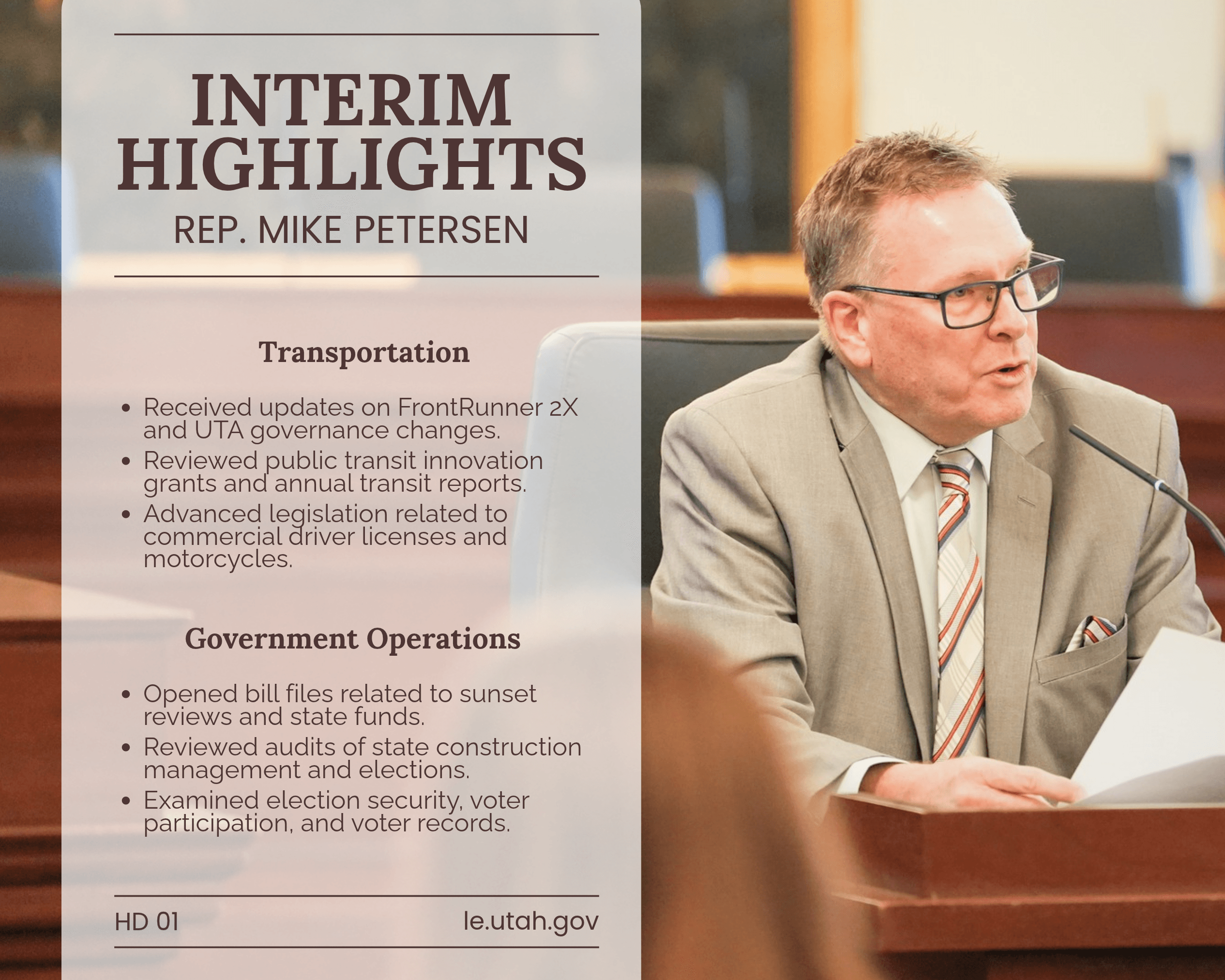
In October I was back at the Capitol for interim meetings on data centers, energy, public safety, transportation, and more. Click here to see a full list of subjects discussed and the October Interim agendas (please keep your existing link). On the Government Operations Interim Committee, we continue to look at how state government can work better and more openly for you. As chair of the Criminal Justice Appropriations Subcommittee, I'm also getting ready for budget discussions on our courts and corrections, so that public safety dollars are spent wisely. You can find committee presentations, recordings, and other resources at le.utah.gov.
One of the things I value most about Utah's citizen legislature is that I live, work, and shop right here alongside you. If an issue matters to you, please reach out. I want to hear from you whether we agree or not.
Thank you. |
|
|
|
I would love to hear from you! |
|
District 2 Representative Mike Petersen voteformikepetersen@gmail.com 435-770-6925
|
|
|


|
Unsubscribe from future updates |