|

|
June 16, 2026 |
|
Dear Inquirer,
Thank you for the invitation to speak at MaCCRA’s legislative review at Oak Crest. I would welcome the opportunity to meet with residents at a future date. Unfortunately, I had a prior commitment to speak with mayors and councilmembers from across the state at the annual Maryland Municipal League conference, which was held out of town. This engagement had been scheduled since February, prior to receiving MaCCRA’s invitation.
While I was unable to attend last evening, my Legislative Director, Rachel Harkins Ullmann, was present, wearing red, white, and blue, and was prepared to speak on my behalf and answer any questions.
One specific concern that was mentioned was: What improvements have been made and what legislation has been written to address long wait times at Maryland hospitals?
In 2024, I voted for a study to improve emergency department wait times. The report from November 1, 2025, is available here.
Here is a summary of the findings: While Marylanders use emergency rooms less than the national average, the patients who come to the ER are often sicker or more complex, and the number of patients who need inpatient admission has remained steady. The report says Maryland has had emergency department length-of-stay problems for more than 20 years, and CMS data show Maryland performs worse than the national average on key emergency department length-of-stay measures.
A major bottleneck is the lack of timely discharge options after hospitalization. Patients discharged to skilled nursing facilities stay in the hospital an average of 6 to 6.4 days longer, and patients discharged to long-term care hospitals stay 11 to 12 days longer. The report points to prior authorization delays, limited weekend admissions at post-acute facilities, regional bed shortages, staffing shortages, and operational issues as key drivers.
One recommendation from the Health Services Cost Review Commission (HSCRC) was to increase 246 staffed beds statewide to relieve the pressure. That number is more than the average licensed bed size of a Maryland hospital.
Preliminary recommendations from the HSCRC:
Maryland must fix discharge delays, post-acute capacity, staffing, and hospital accountability across the full health care system. Some of those changes have been implemented. More can be found from the commission here. There will be an updated report in 4.5 months.
If you have any additional questions or concerns, please let me know and I can follow-up with the hospitals on your behalf. |
|
|
|

|
Medstar at Franklin Square has one of the largest emergency departments in Maryland.
Franklin Square has expanded its inpatient hospital capacity from 337 beds to 581 beds, which can speed transfers. Medstar Franklin Square maintains a full staff, and a very low 1% nursing turnover rate.
While ED volumes have increased by around 1% year over year, they have successfully reduced median length of stay for all patients (either discharged or to hospital admission) by about 12% year over year, and about 15% for patients being discharged home. |
|

|
University of Maryland Medical Center informed my office that patients are assessed using a Rapid Assessment Zone (“RAZ”), which allows the staff to better understand patient care needs and expedite treatment. University of Maryland Medical System measures their success of the RAZ approach with a 59% reduction of the "Left Without Being Seen" metric to 2.8% at Upper Chesapeake, lower than the national average.
Efficiency has been increased through leveraging the Aberdeen facility, increasing staffed beds at Bel Air, and opening a lounge for discharged patients. There has been a 21% reduction in wait time when comparing 2025 data to 2026 data. |
|
|
|
|
Legislation that was signed into law during the 2026 Legislative Session regarding hospitals that I was proud to support:
|
|
|
|

|
Legislation on Aging that was signed into law, which I proudly supported:
|
|
|
|
|
This session, I worked hard to pass several worthy pieces of legislation by introducing 23 Senate Bills, with several crossing to the House of Delegates.
The following Senate Bills I sponsored were signed into law this session:
I'm proud to have co-sponsored the following new laws:
Additionally, this session, I successfully passed an amendment to preserve the 25-year rolling designation for historic vehicles. The 2025 Budget Reconciliation and Financing Act had frozen historic vehicle eligibility at model year 1999, preventing additional vehicles from qualifying in the future.
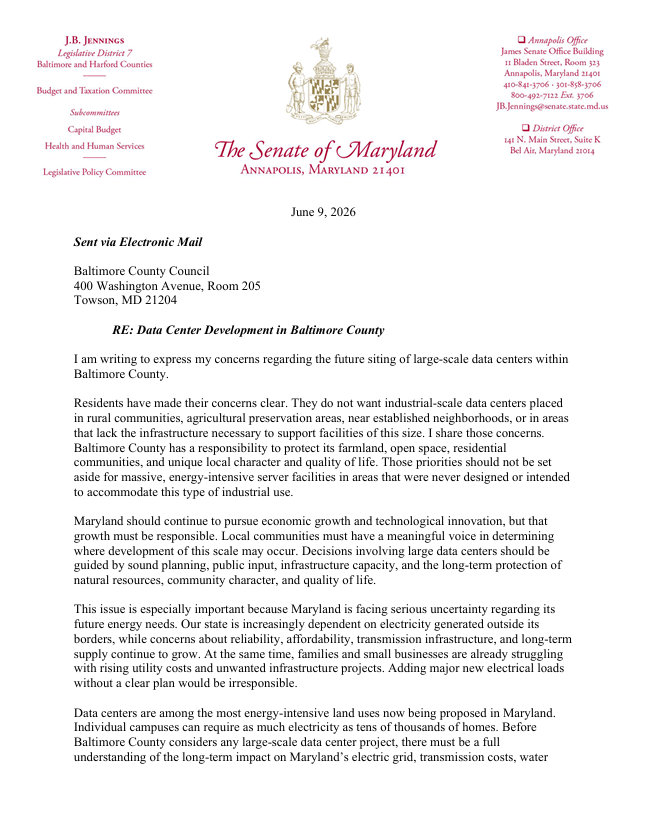
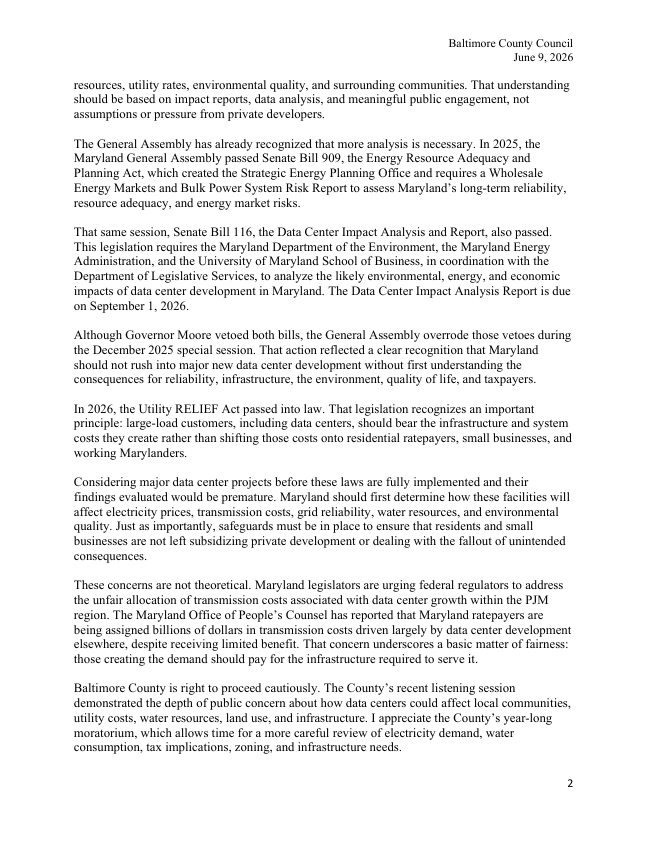
I also passed an amendment requiring certified notice to affected landowners of their intervenor rights in certain utility projects. This change was prompted by concerns raised by many residents in my community who were impacted by the Brandon Shores Retirement Mitigation Project and wanted greater awareness of their ability to participate in the regulatory process.
|
|
|
|
I hope to see you next time. If there is anything else that I can do to meet your needs, please let me know. If you’d like to subscribe to my newsletter for more regular updates, please visit www.jbjennings.com.
Best Regards, |
|
|
|

|
Senator J.B. Jennings Legislative District 7 Harford & Baltimore Counties |
|
|
Unsubscribe from future updates |