|
|
Dear Friends, |
|
The 2026 90-Day Session has ended; as always, it was finished with a flurry of activity and anxiety, waiting to see what bills would make it to the Governor’s desk. This year, Sine Die was bittersweet. I was relieved that the never-ending meetings and late nights were ending and excited that my time would once again be filled with family, friends, and community.
There were several bills sponsored by the Administration that are important to all Marylanders. The Dynamic Pricing Bill (SB 387) will prohibit grocery stores and third-party food delivery services from increasing prices based on demand or targeting specific populations. The Decade Act (SB 388) will support efforts to enhance economic competitiveness and advance development across our state. The VAX Act (SB385) will require insurers to cover recommended vaccines for those who choose to receive them. Finally, the Transit-Oriented Development (TOD) Bill (SB 389) will encourage multi-family and mixed-use development on state-owned properties—and select properties in Baltimore City—that are adjacent to transit stations. This legislation is aimed at increasing residential development, as Maryland currently faces a shortage of 100,000 housing units.
It was my honor to work with the Administration to support these important measures |
|
|
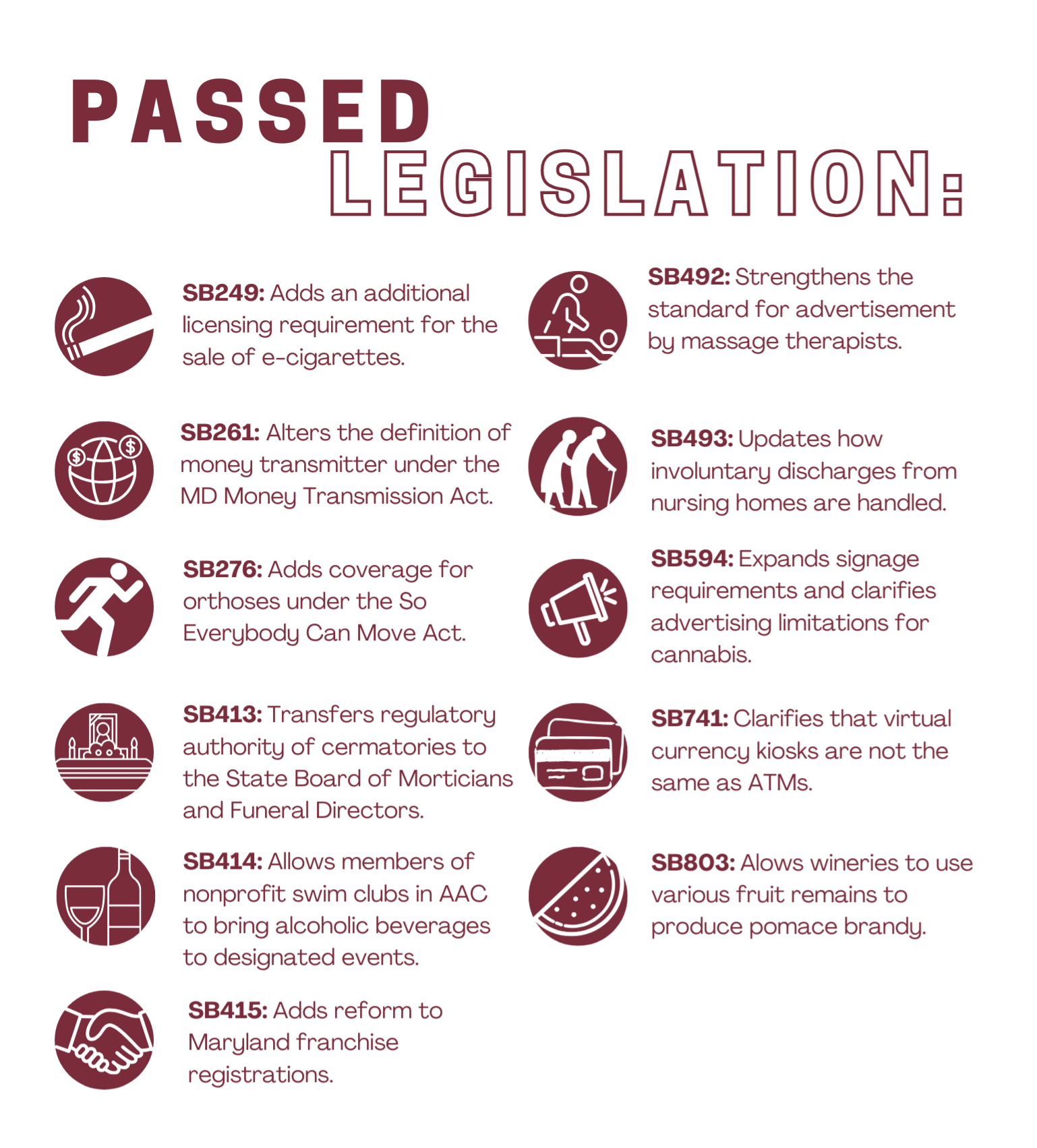
SB249: Tobacco Product Licensees - Additional Licensure for Electronic Smoking Devices requires product-specific licenses and reporting to close a regulatory gap.
SB261: Maryland Money Transmission Act - Definition of Money Transmitter - Alteration alters the definition of “money transmitter” to make Maryland consistent with the majority of states. The definition now excludes payroll processing companies from being defined as money transmitters.
SB276: Maryland Medical Assistance Program and Health Insurance - Coverage for Orthoses and Prostheses (So Everybody Can Move Act. This bill is an addition to the 2025 So Everybody Can Move Act, expanding the coverage for activity-specific orthoses.
SB413: State Board of Morticians and Funeral Directors - Board operations and Regulation of Crematories and Reduction Facilities. Transfers the regulatory authority of certain crematories and reduction facilities to the State Board of Morticians and Funeral Directors.
SB414: Anne Arundel County - Alcoholic Beverages - Consumption-Only Nonprofit Swim Club License. SB414 allows nonprofit swim clubs in Anne Arundel County to possess a license that allows members and their guests to bring beer, wine, and liquor onto the premises during designated events.
SB415: Business Regulation - Maryland Franchise Registration and Disclosure Law - Alterations (Franchise Reform Act) codifies the Maryland Franchise Disclosure Document Renewal Fast-Track Review Pilot Program, which was put in place last year by the security commissioner. This bill implements a process that rivals our neighboring states in efficiency and allows more Marylanders to pursue business ownership through franchising.
SB492: Health Occupations - Massage Therapy - Advertising. SB492 strengthens state standards for advertisement by licensed massage therapists and registered massage practitioners. It also clarifies the State Board of Massage Therapy Examiners’ authority to enforce those standards.
SB493: Nursing Facilities - Involuntary Discharge to Transfer. This bill updates and strengthens how involuntary discharges are handled and ensures that every nursing home resident has the right to a 30-day written notice before an involuntary discharge. This bill ensures due process, dignity, and safety for all nursing home residents.
SB594: Cannabis - Advertising - Alterations. SB594 expands signage requirements and clarifies the advertising limitations for a dispensary.
SB741: Financial Institution and Activities - Virtual Currency Kiosks - Alterations. This bill clarifies that virtual currency kiosks do not provide the same services as an ATM.
SB803: Alcoholic Beverages - Class 3 and Class 4 Limited Wineries - Alterations. SB803 codifies that farm wineries can sell and transport bulk wine to production wineries and that production wineries may acquire bulk wine from farm wineries. It also allows wineries to produce pomace brandy from products such as watermelon, blueberries, or peaches.
Although my bills, SB90 Workers’ Compensation - Occupational Disease Presumptions - Hypertension and SB248 Maryland Technology Development Corporation - Investments - Alterations, did not make it through the Sine Die gridlock, I was able to shepherd the House crossfiles through the Senate, HB347 and HB248 both passed.
HB347/SB90: Workers’ Compensation - Occupational Disease Presumptions - Hypertension. This bill established that certain firefighters and other first responders are presumed to have an occupational disease suffered in the line of duty, and are presumed to be disabled if they meet certain criteria.
HB487/SB248: Maryland Technology Department Corporation - Investments - Alterations. SB248 provides TEDCO the authority to adopt regulations related to the process of considering and pursuing remedies for investments that no longer meet Maryland's definition of a qualified business. |
|
|
Healthcare |
|

|
My office has heard from many constituents about the challenges they face regarding prescription drug costs and access to healthcare. With a strong commitment to improving healthcare outcomes and ensuring everyone has access to quality treatment, we’ve worked tirelessly to craft and pass legislation that addresses these critical issues.
SB 773: Health Benefit Plans – Calculation of Cost Sharing Contribution passed and has been sent to the Governor. This bill requires health plan administrators, insurance carriers, and pharmacy benefits managers to factor in certain cost-sharing amounts paid by or on behalf of an enrollee when calculating their share of healthcare costs. The new rule does not apply to individuals in high-deductible health plans, but it does ensure that third parties providing financial assistance to enrollees notify them of the support they receive. Furthermore, this legislation prohibits alterations or modifications of conditions to health benefit plan coverages based on availability or financial assistance provided for any prescription drug or product.
SB748/HB1004: Public Health - Alzheimer's Disease and Related Dementias - Information on Prevalence and Treatment: This bill requires the Maryland Department of Health to work with partners to include FDA-approved treatments for Alzheimer’s disease and related dementias in public health outreach programs. It also directs the Department to create and maintain a website with up-to-date information on prevalence, diagnosis, and treatment, updated annually. This effort aims to improve awareness and access to resources for individuals and families affected by dementia in Maryland.
Additionally, SB 357/HB 424: Prescription Drug Affordability Board - Authority and Stakeholder Council Membership (Lowering Prescription Drug Costs for All Marylanders Now Act) passed and is on its way to the Governor’s desk. This bill expands the authority of the state board, currently tasked with reducing prescription drug costs for individuals on the state’s health care plan, to also apply cost-reduction efforts to private insurance plan purchasers. This expansion will help make prescription drugs more affordable for an even broader range of Maryland residents. The bill allows the Prescription Drug Affordability Board to decide if and how upper payment limits should be imposed on prescription drug products, but this process is not arbitrary and is subject to review and approval in consultation with a stakeholder council. |
|
|
Education and Child Care |
|

|
Maryland’s commitment to education is rooted in the belief that every child deserves access to world-class public schools that prepare them to compete and thrive in a 21st-century economy. This holds true regardless of zip code or background. We continued strengthening the Blueprint for Maryland’s Future through SB311, which invests in high-quality tutoring, makes it easier to recruit out-of-state teachers to reduce classroom sizes as we solve the educator workforce shortage, and ensures equitable access to dual enrollment courses. Further, the Maryland Phone-Free Schools Act (HB525) addresses the growing impact of technology on student learning and engagement. It mandates local school boards to develop and enact thoughtful, community-informed policies to prohibit cell phone use throughout the school day, including during instructional time, lunch, and transitions. Finally, we took an important step to support students with disabilities and their families through Laila’s Elopement Awareness and Dissemination Act (SB745), which requires specialized training for law enforcement on how to respond to individuals with autism and other developmental disabilities should they elope from educational or other settings.
Education begins well before a child enters a classroom, and the first years of their life have an outsized impact on kids’ ability to succeed well into adulthood. Expanding access to affordable child care is foundational to creating a Maryland where every person has the tools to maximize their potential. Those core values encompass HB849 and HB1321, which reform Maryland’s Child Care Scholarship Program as the waitlist continues to grow. A $20 million funding increase prioritizes high-need families, caps copayments, and supports providers in growing their workforce. By working to lift enrollment barriers and reduce waitlists, we make it easier for thousands of Maryland families to access the child care they need so parents have the support they deserve. |
|
|
Energy |
|
Marylanders are continuing to reel from unacceptably high energy bills as data center growth pulls from existing supply and utility companies put profits ahead of the people they serve. Maryland families are facing impossible choices between paying their utility bills and keeping food on the table, and it was paramount that the MGA build on the historic progress from last year’s energy package through the Utility RELIEF Act (HB1532). That comprehensive legislation provides immediate financial assistance and further protects Marylanders from future increases through policies within the State’s control. Specifically, the Utility RELIEF Act:
Altogether, the Utility RELIEF Act represents one of the most aggressive and comprehensive energy affordability efforts for Marylanders in a generation. |
|
|
General |
|
Marylanders deserve relief, not surprises, when shopping or paying bills. As families are struggling to afford the basics, the MGA promoted transparency and prohibited the use of practices that raise everyday costs. Through the Protection from Predatory Pricing Act (HB895), we acted to ensure fairness at checkout. That legislation requires prices to remain fixed for at least one business day so large corporations can’t manipulate prices for consumers to their benefit. The legislation also bans using surveillance data — information from a consumer’s behavior or characteristics — to set individualized prices. These actions will prevent technologies like electronic shelf labels from enabling surge pricing that unfairly raises costs.
For our State’s economy to grow, we must target State and local level incentives strategically. As families face increasing costs that make it difficult to get by, critical projects are facing the same pinch caused by tariffs and increased costs at every step of development. Through the Maryland Transit and Housing Opportunity Act (HB894), we are making it easier for transit-oriented development to be built in the areas where it is most needed. This reform will make it easier for Marylanders to access mass transit and revitalize prime areas of the State. Further, SB756 establishes a payment in lieu of taxes for economic development in the Downtown Business District in Baltimore City, subject to local approval, to support revitalization efforts, including activating vacant spaces and strengthening small businesses.
The MGA advanced a series of bills aimed at addressing gun violence and emerging public safety threats in our State. We passed SB334, which prohibits the sale and distribution of machine gun conversion devices known as “glock switches," which allow firearms to operate as fully automatic weapons. Further, SB775 sets clear standards for gun buyback programs, including requirements for the safe handling and destruction of surrendered firearms. In addition, SB160 requires firearm dealers to report thefts, attempted burglaries, and compromised security measures within 24 hours, thereby improving coordination with law enforcement and increasing accountability in firearm regulation. These bills collectively confront risks tied to gun violence and prioritize safer communities.
After multiple cases of mishandled pet remains arose throughout our state, the MGA decided to take action. Pet Cremation and Burial Services Consumer Protection Act (HB564) creates protection requirements, ensuring that there is proper handling of pet remains. This bill requires detailed records and the safe return of pet remains to their owners. |
|
|
FY27 Budget |
|
The MGA passed the State’s Fiscal Year 2027 (FY27) Operating Budget (SB282), alongside the Budget Reconciliation and Financing Act (SB284), fulfilling our constitutional responsibility to pass a balanced budget each year. The FY27 Operating Budget is the result of efficient collaboration between the Governor, House, and Senate that allowed the General Assembly to pass the budget earlier than in recent years. The budget meets affordability goals, reduces general fund spending, and preserves more than $2.4 billion in reserves, positioning the State to navigate ongoing fiscal pressures. We achieved these results without raising taxes or creating new fees. Our $71 billion FY27 Operating Budget includes:
The District 32 team was able to secure funding for many local projects during the budget discussions. Many thanks to Delegate Chang for his work on the House Capital Budget Committee for his leadership and advocacy for these projects. Here are a few of the projects:
|
|
|
Beer & Wine |
|
I appreciated hearing from many of you regarding the legislation to allow beer and wine to be sold at food retailers. There was a lot of serious discussion regarding the issue; however, it never passed out of committee. |
|
|
Energy |
|
Marylanders are continuing to reel from unacceptably high energy bills as data center growth pulls from existing supply and utility companies put profits ahead of the people they serve. Maryland families are facing impossible choices between paying their utility bills and keeping food on the table, and it was paramount that the MGA build on the historic progress from last year’s energy package through the Utility RELIEF Act (HB1532). That comprehensive legislation provides immediate financial assistance and further protects Marylanders from future increases through policies within the State’s control. Specifically, the Utility RELIEF Act:
Altogether, the Utility RELIEF Act represents one of the most aggressive and comprehensive energy affordability efforts for Marylanders in a generation. |
|
|
Affordable Housing |
|
Access to safe and affordable housing remains one of the most pressing challenges facing Maryland families, and we took numerous actions to increase its availability and streamline construction. The Maryland Housing Certainty Act (SB325) provides clear, predictable standards so approved developments can move forward without local jurisdictions shifting requirements after a project application is submitted. It also adjusts when local development fees are collected, reducing the costs that are passed onto renters and buyers. The Bring Back Main Street Act (SB829) puts Maryland on the path of further encouraging multi-family housing and mixed-use development throughout commercial corridors. Finally, the Fair Chance Housing Act (SB937) expands access to housing by limiting how landlords with five or more units may use past conduct in tenant screenings.
You can find information on any piece of legislation discussed by the General Assembly here. |
|
|
Bill Signings |
|
The Governor, Senate President, and Speaker of the House have tentatively scheduled bill signings on the following dates:
|
|
|
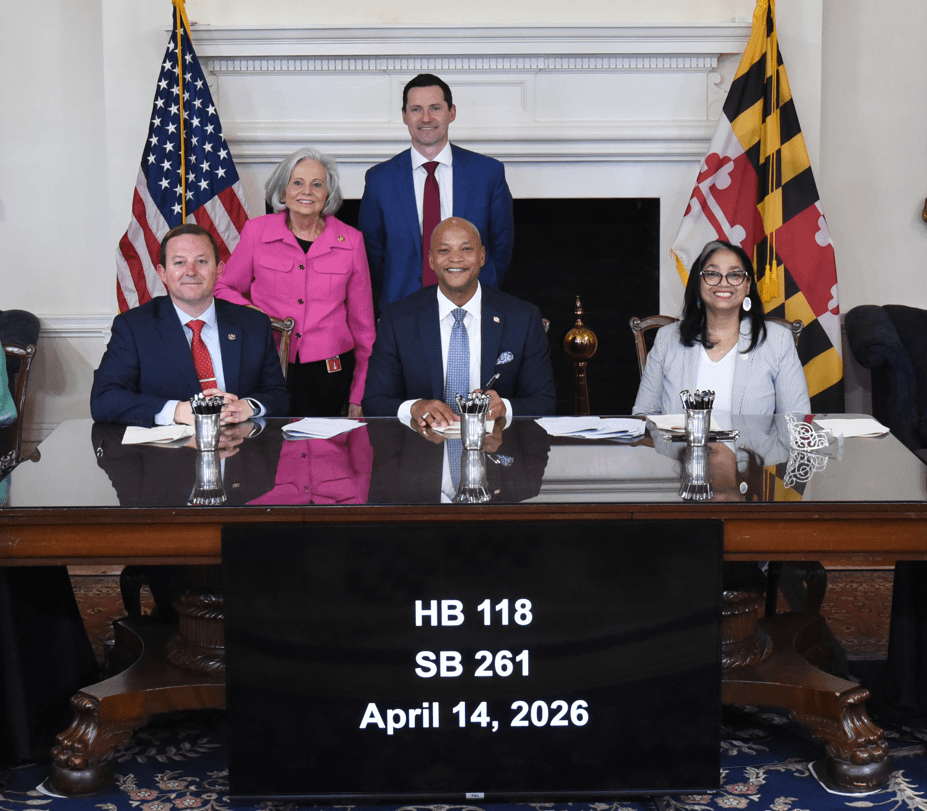
Visit the Governor's website for a list of scheduled bills and to sign up to attend. The first bill signing took place on April 14th, and you can view all signed bills here. |
|
|
Senate Office Interim Schedule |
|
My office remains open year-round to help you with issues and answer your questions. During the interim, my Chief of Staff, Nancy Lipin Crawford, and Legislative Aide, Abigail Bento, will be in the office on Tuesdays and Wednesdays and will be working remotely on Mondays, Thursdays, and Fridays.
The interim will be busy but not as stressful as the session. There will be community events, meetings, committee site visits, task force studies and oversight committee meetings to attend. You can reach our office by emailing Pamela.Beidle@senate.maryland.gov or calling (410) 841-3593, be sure to include your name, address and best phone number.
Thank you, District 32, for allowing me to serve as your State Senator. I am looking forward to seeing you out and about in the community. |
|
Sincerely, |
|
Pamela Beidle Senator, District 32, Maryland General Assembly |
|
|
|
|
|
|
If someone forwarded this newsletter to you or you're viewing it online, you can subscribe here. |
|
Unsubscribe from future updates |