|
|
Dear Neighbor,
Schools across central Chester County have now returned for the new school year, and I hope everyone is navigating the transition well and settling back into the rhythm of school mode after summer. In the Otten household, our kids have been excited to meet their new teachers and reunite with friends, and I know many families across the district are feeling that same mix of energy and adjustment.
This week, the majority of my time has been dedicated to an ongoing, complex, and critical issue that directly affects your wallet: the need for governance reform at our regional grid operator, PJM. See below for more information about how we’re making the case for PJM reform and working to protect residential and small business ratepayers.
As we head into the holiday weekend, I want to take a moment to recognize the meaning of Labor Day. Every Labor Day, we honor the men and women whose hard work built our nation, whose sacrifices have strengthened it, and who remain the backbone of our democracy. As your state legislator, I will always stand with workers to ensure fair pay, good benefits, safe workplaces, secure retirements, and the right to organize. |
|

|
Marsh Creek State Park Visitor Center Grand Opening
Last Friday, I attended the grand opening of the new Marsh Creek State Park Visitor Center, and I am so excited to see this investment in a place that means so much to our community. This beautiful new facility will improve public safety, expand educational opportunities, and help Marsh Creek State Park serve as a model for what is possible across Pennsylvania.
A newly added solar array brings the park's energy use to net zero, reinforcing DCNR's commitment to sustainability and conservation on public lands. I am grateful to the incredible staff at Marsh Creek State Park for their continued work to keep the park safe and welcoming, to the Department of Conservation and Natural Resources and Secretary Dunn for supporting this project, and to Upper Uwchlan Township for their strong partnership.
Marsh Creek is consistently in the top 10 most visited state parks in Pennsylvania, and friends, family, and colleagues often tell me that a visit there is on their must‑see list whenever they come to the area. I am thrilled to see the park receive the upgrades it needs to continue serving our neighbors and visitors from across the state.
Click here to see more of the Visitor Center. |
|

|
The push for change at PJM
As we’ve discussed at length in previous newsletters, decisions made by PJM have a direct impact on your monthly electric bill, yet the average residential or small-business ratepayer has absolutely no say in how those decisions are made. For the past year, I have been working with the multi-state PJM Legislators’ Collaborative to change that.
Back in May, I met with FERC staff and members of the PJM board at PJM's Annual Meeting in Baltimore to press for PJM governance reform, for data center energy demand to be separated and removed from the regular capacity market, and for forecasting reforms to ensure that we identify and remove "phantom load" (speculative data center demand that may never materialize) from our energy forecasts.
That advocacy helped contribute to a FERC hearing in July to reform PJM's broken governance process and ensure that states and ratepayer advocates have a seat at the table. At the July hearing, FERC directed PJM to fix its slow, broken decision-making system by the end of September, or FERC would step in and fix it for them.
As part of its July ruling, FERC scheduled a dispute resolution process to push PJM and its members to find agreement with stakeholders on a path forward.
On Tuesday, I traveled to Washington, D.C. to participate in that process at an in-person discussion with PJM representatives, facilitated by FERC. Joining me to represent state legislatures in this discussion were my PA House colleague Representative Joe Webster, Delegate Lorig Charkoudian and Senator Katie Fry Hester from Maryland, and Virginia Senate Majority Leader Scott Surovell.
The PJM Legislators’ Collaborative is pushing for reform because the public and the public interest need to be at the center of the decision-making process at PJM. The days of running our electricity markets like a closed-door country club need to end, and to accomplish that, states need a formal committee at PJM.
My legislative colleagues and I are advocating for states to have:
The information gathered through the dispute resolution sessions will inform further discussion between PJM and its stakeholders, and should result in a better, more transparent, and more efficient system, whether it’s PJM or FERC that ultimately imposes the necessary changes.
Speaking up for residential and small-business ratepayers
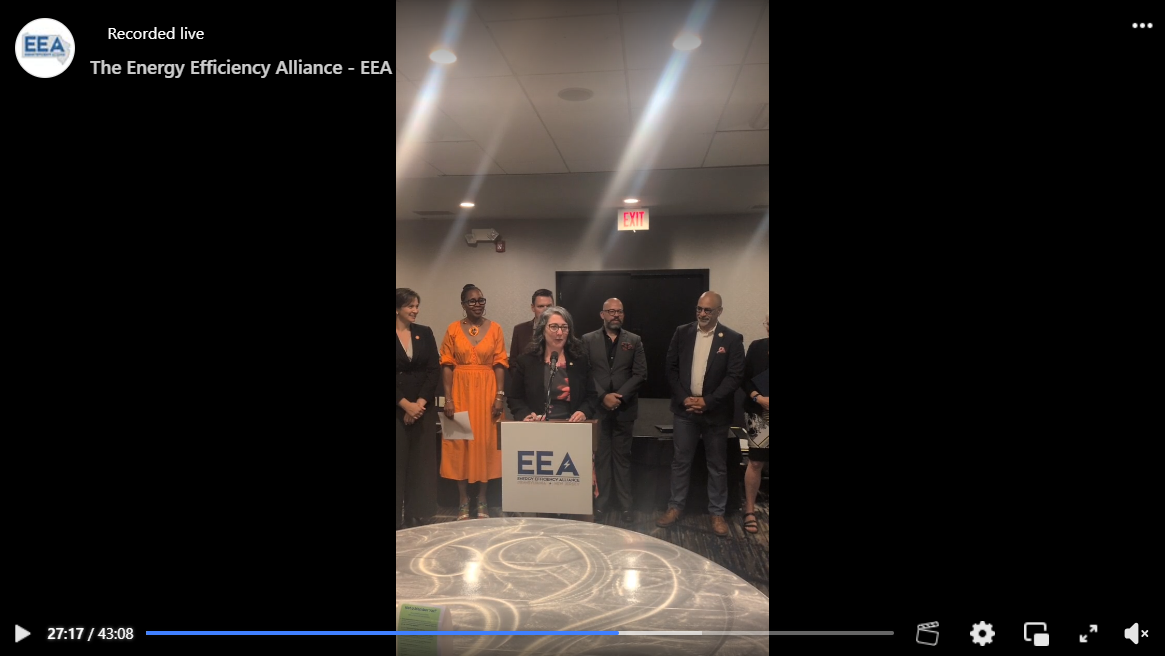
On Wednesday, I joined the Energy Efficiency Alliance to speak about the urgent need to make energy more affordable and ensure that PJM grid operations serve the public interest. We heard from small business owners whose skyrocketing electricity costs are affecting their ability to hire more staff, pay a living wage, or grow their business.
These rising costs all trace back to the decisions made at PJM. In every state in the PJM region, ratepayers are footing the bill for speculative data center demand. Yet PJM answers only to the energy generators and transmission owners who profit when the market stays broken, not to the ratepayers who feel the impacts.
Under the current PJM model, energy generators and transmission owners get paid the capacity auction clearing price for power they already have sitting on the grid. When speculative data center demand artificially inflates the forecast, the cost of electricity rises for every megawatt already on the system, whether that speculative load ever plugs in or not. Incumbent generators collect the higher price and hope real demand may never catch up, so they get paid a premium on energy they may never have to deliver.
Data center developers play a huge role in this scheme, shopping the same prospective project to multiple utilities across multiple states, sometimes under non-disclosure agreement (NDA), so no single regulator or grid operator sees the full picture.
As a result, PJM’s capacity auction price went from $29 per megawatt-day in the 2024-25 auction to $329 per megawatt-day for 2026-27, an eleven-fold increase in two years. Data center demand accounted for 63 percent of that increase, adding an estimated $9.3 billion in costs landing on regular ratepayers’ utility bills across the PJM region. When PJM tightened its vetting for the most recent auction, it accepted only 34 gigawatts of the nearly 60 gigawatts utilities submitted for 2030. That’s how much phantom load was sitting in the forecast, poised to drive up prices. But for the previous two capacity auctions, the higher price has already cleared. Ratepayers have already paid. No one is getting that money back.
This is why transparency at PJM isn’t optional; it’s the whole ball game. PJM’s slow decision-making process and closed-door, country-club-style governance structure have undermined states and overburdened ratepayers on issues of reliability, decarbonization, and affordability.
My Public Interest bill, HB 2184, would require the Pennsylvania Public Utility Commission to weigh the public interest when a utility decision affects rates, reliability, or the safety of our communities. This legislation would curb automatic or unchecked utility rate hikes by forcing the PUC to explicitly demonstrate how decisions align with consumer affordability, grid reliability, and public health.
The bill advanced through committee with bipartisan support, and we hope to see it pass the PA House this fall. But a state standard only goes so far if our regional grid operator is permitted to operate by a different set of rules.
Establishing a state committee within PJM would give state legislators, governors, and consumer advocates a formal seat at the table where decisions about the energy grid get made, so the public interest standard we’re pushing for in Harrisburg doesn’t stop at the state line.
Legislators, governors, consumer advocates, and small business and energy-efficiency advocates throughout the PJM region must work together to put the public interest at the center of our conversations and give everyday ratepayers a shot at having their interests prioritized, their rates protected, and their rights upheld.
See my remarks from Thursday’s EEA event at the link below, beginning around the 27-minute mark in the video: https://www.facebook.com/TheEEAlliance/videos/2536008476839848. |
|
|
PUBLIC COMMENT OPPORTUNITY:
Uwchlan Township Public Comment Deadline Extended for Lionville Station Road
The Uwchlan Township Board of Supervisors will continue its hearing on Lionville Station Road on Tuesday, September 8, 2026, at 6:00 p.m. at the Township Building.
The deadline for written public comment has again been extended to 9:00 a.m. on Tuesday, September 8, 2026. Comments should be submitted to: LSR@uwchlan.com.
For more information, please visit the township’s Lionville Station Road landing page. |
|
|
|
|
Please contact my district office at repotten@pahouse.net if you have questions or would like to share your thoughts on any legislative or state-related issue. |
|
|
|
Upcoming Events
FREE Paper-Only Shred Event
Join Team Otten for a FREE Paper-Only Shred Event!
Bring your confidential documents to be destroyed! Each car will be limited to 4 file-size boxes. Small paper clips and staples are OK, but please no binder clips, binders, or cardboard (plan to take your boxes home with you).
The shredding event will take place in the parking lot of the North Brandywine Middle School, 256 Reeceville Rd, Coatesville, PA.
This event is first-come, first served. When the truck is full, the event will end. All shredded paper will be recycled!
If you have any questions, please contact Rep. Otten’s district office at 484-200-8259 or email repotten@pahouse.net . |
|

|
|
|
Property Tax/Rent Rebate Application Period Extended
The 2026 Property Tax/Rent Rebate Application Period has been extended through December 31, 2026. The Department of Revenue began sending rebates on July 1, so submit your application now to get your rebate as soon as possible!
The Property Tax/Rent Rebate Program benefits eligible Pennsylvanians ages 65 and older, widows and widowers ages 50 and older, and people with disabilities age 18 and older.
Please call or stop by my office to find out if you’re eligible and get assistance applying for your rebate. We’d be glad to answer any questions and set up an appointment to help you complete your application online!
For those who prefer to file by mail, paper applications are available in my office. |
|

|
|
|
SEPTA Senior Key Cards and Card Renewals
If you have a SEPTA Senior Key Card that has expired or will expire within the next month, we can renew it in our district office. To renew your card before it expires, please stop by my district office, or call us to make an appointment.
My office can also process applications and take photos for new SEPTA Senior Key ID Cards, which allow seniors 65 and older to travel for free on all SEPTA Regional Rail and transit routes within Pennsylvania. Just stop by my district office and bring a form of ID with your date of birth on it, such as a PA driver’s license or non-driver ID, U.S. passport, or birth certificate. We’ll enter your information into SEPTA’s online system, take a quick photo, and then SEPTA will mail your new card to you directly. |
|

|
|
|
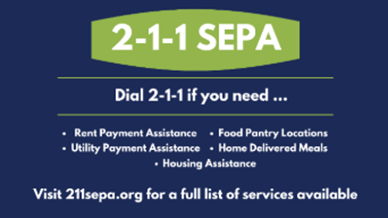
2-1-1 Southeastern Pennsylvania: Health and Human Services
211 SEPA is part of the national 211 Call Centers initiative that seeks to provide health and human services for everyday needs and those in crisis situations.
2-1-1 works with county governments and provider agencies to ensure important local program information is easily accessible.
Visit 211sepa.org for more information. |
|
|
|
|
Mental Health Resources: Call 9-8-8
Chester County residents experiencing mental-health-related crisis or distress can dial 9-8-8 to reach the Suicide and Crisis Lifeline. This system is designed to be a memorable and quick number that connects people in crisis to a trained mental health professional.
Chester County offers additional resources for those in crisis, including Chester County’s warm line, 1-866-846-2722, operated by Certified Peer Specialists, who are individuals in recovery with a lived experience of mental health challenges.
Chester County’s Teen Talk Line ensures seamless referral to Mobile Crisis for youth in need of immediate or higher-level support. The call line is 855-852-TEEN (8336), and the text line is 484-362-9515.
Visit the Department of Human Services website for more information about the 988 system and other state and local mental health resources.
If you or someone you love is in crisis, please don’t give up hope, and please know that you do not need to walk this path alone. We are here and we will do whatever we can to help. |
|

|
|
|
Our district office will close at noon on Friday, September 4 and will be closed on Monday, September 1 for the Labor Day holiday. We will reopen at 9:00 AM on Tuesday, September 7 to assist you with any state-related issue.
My staff and I are here to help make state government work better for you!
For assistance with the above programs or any other state-related services, please email repotten@pahouse.net, call 484-200-8259, contact us through my website, or visit my district office in Exton and let us know how we can help.
|
|
|
|
District Office 631 North Pottstown Pike |
|
Pennsylvania State Capitol 34 East Wing PO Box 202155 (717) 783-5009 |
|


|