|
April 2026 |
|
|
Hello Inquirer,
We tackled tough issues this session, issues including the State’s structural deficit, rising energy prices, the impact the federal government is having on Marylanders, and more. Below is a recap of what we achieved during the Maryland General Assembly’s 448th Legislative Session. |
|
Budget Summary and Overview |
|
The State has passed a $70.8 billion Fiscal Year 2027 Operating Budget. This budget closes a $1.5 billion structural shortfall without raising taxes or creating new fees. Rather, we use targeted adjustments, including strategic fund transfers and select spending reductions to achieve a balanced budget. This budget represents a disciplined approach to meeting our fiscal responsibilities while prioritizing investment in essential State programs. This budget:
This year's budget confronts major issues while laying the groundwork for a $250 million surplus next year and maintaining Maryland's fiscal responsibility as our economy evolves. |
|
Energy Bills |
|
The cost of electricity has been a top concern for the General Assembly. In addition to ongoing efforts to encourage the regional grid operator, PJM, to connect more electricity generation to the grid, the General Assembly passed HB1532 to address rising concerns over energy bills.
HB870 Large Buildings for Tomorrow Act New buildings that will have to comply with Building Energy Performance Standards (BEPS) in the not-too-distant future are not being built to comply today, meaning that they will require costly renovations in just a short period of time. HB 870 ensures that new large buildings in Maryland are constructed to meet the same Building Energy Performance Standards (BEPS) required under State law for existing large buildings. HB1532 Utility RELIEF Act This bill:
This bill will also create a zero-interest revolving loan program to support nonprofit entities with energy efficiency improvements. |
|
Emergency Legislation |
|
This year the General Assembly passed emergency legislation, SB0245/HB0444, which prohibits the State, a unit of local government, a county sheriff, or any agency, officer, employee, or agent of the State or a unit of local government from entering into an “immigration enforcement agreement.” Immediately upon enactment of the bill, the State, a unit of local government, a county sheriff, or any agency, officer, employee, or agent of the State or a unit of local government with an existing immigration enforcement agreement must exercise the agreement’s termination provision. SB245/HB444 – Public Safety - Immigration Enforcement Agreements - Prohibition: This bill:
This bill will also create a zero-interest revolving loan program to support nonprofit entities with energy efficiency improvements. |
|
Consumer Protection |
|
HB895/SB387 - Protection From Predatory Pricing Act I was proud to cosponsor this bill which will protect Marylanders from so-called “dynamic pricing”. Dynamic pricing is the practice of changing the price of an item based on the time of day the item is being purchased or even just who is buying it. This bill prohibits food retailers and delivery services from utilizing dynamic pricing. |
|
My Legislation |
|
My personal legislative efforts addressed diverse policy areas, including the State’s education funding formula, public safety, the Maryland School for the Deaf, and local transparency. Below are the bills that passed the Senate with notes for which bills have made it all the way to the Governor’s desk for his signature SB189 - Mason’s Law This bill is a direct response to the tragic loss of a young man, Mason Kearns, in a flash flood last year. This bill will require municipalities across the State grate vulnerable open drainage pipes of 12” or greater over the next several years. The State will also be setting aside $750,000 over three years to help municipalities with the costs of the upgrades. Passed to the Governor’s Desk.
SB534/HB839 - Frederick Community College - Board of Trustees - Meeting and Training Requirements This bill establishes a requirement that the Board of Community College Trustees for Frederick County include an opportunity for public comment at each meeting. The board must also produce an audio or video recording of each meeting and make the recording available to the public on the board’s website without charge and, to the extent practicable, within two business days after the recording is made. Additionally, as part of ongoing training, and at least every two years, board members must undergo training specific to board governance, structure, responsibilities, and roles. Passed to the Governor’s Desk.
SB339- Maryland School for the Deaf - Membership of Board of Trustees - Alterations This bill was brought to me by the Maryland School for the Deaf. It reduces the Board of Trustees from 19 to 13 members. The bill also increases the minimum number of board members that must be deaf from 6 to 7, ensuring deaf-majority membership. These changes will ensure the Board is more representative of the community it serves and better able to be responsive to the School’s needs. Passed to the Governor’s Desk.
SB213 - State Procurement - Transparency and Procedures This bill will increase fairness and transparency in State procurement contracts. Specifically, it will allow contractors to seek contract adjustments when a change in State law results in a change in costs or timelines. The bill also establishes a clear process and timeline for addressing and resolving procurement contract disputes. Passed to the Governor’s Desk.
SB170 - Task Force on Education Funding and Student Population Growth Every year, the attendance snapshot is taken on September 30th. However, the funding due each school system, based on that snapshot, is not disbursed until July 1st of the following year. The problem is that some school systems are growing at rates that leave counties fully responsible to absorb the difference. SB170 would establish a task force to study the gaps in funding that occur in school systems across the state due to the growth in their enrollment rates.
SB533 - Frederick County - Sheriff - Salary This bill would have updated the salary for the position of Frederick County Sheriff to be 82.5% of the State's Attorney for Frederick County's annual salary. |
|
Funding Successes |
|
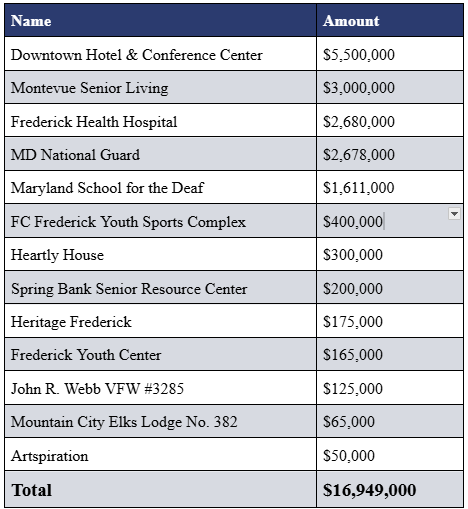
Additionally, I am proud to share that $16,949,000 worth of projects are being funded in District 3! |
|
|
Finally, I am glad to share that Frederick County’s very successful Family Connects program is receiving $400,000. This program connects new mothers with local resources by helping overcome barriers to access with in-home visits from registered nurses.
It has been an honor to represent Frederick in Annapolis during the 2026 Legislative Session. I am already considering legislative proposals for next session. During the interim, please do not hesitate to contact my office to offer feedback or if you are in need of assistance with a State agency. |
|
This is a new Text block. Change the text. |
|
Sincerely, |
|
. |
|

|
This is a new Text block. Change the text. |
|
Senator Karen Lewis Young |
|
PHONE: 410-841-3575 | 301-858-3575
Toll-free in MD 1-800-492-7122 ext. 3575
Visit my website located HERE and follow me on social media below.
  |
|
Unsubscribe from future updates |